Showing posts with label Politics. Show all posts

Wednesday, June 15, 2022

Banality, Ineptitude, and the Unbearable Vapidity of the Disinformation Age - A Dispatch From The Front

 While we can find some relief that our nation barely escaped a coup and no longer is under the grifting thumb of Il Douche directly, this is but a mere temporary reprise. The internet, once a shining promise of information, has devolved into a gaping sewer hole of disinformation and outlandish imbecility. 
While this in itself is hardly news, we the people who prefer self governance to tyranny (and can discern the distinction between them) must keep abreast of the situation even if the conditions of public policy making are found to be repugnant. We have met the enemy, and he is willful ignorance.  


Dispatch From The Front -


What's happening?

Even with Il Douche not in office, QAnon beliefs continue to infect politics.

Why it matters

The debunked conspiracy will be in play during the upcoming midterm elections, but that doesn't mean you have to fall for it.

QAnon, a fringe right-wing conspiracy theory centered on former President Donald Trump, didn't fade away when he left office. Instead, belief in the wild conspiracy persists and continues to play a part in the political discourse, whether Americans realize it or not.

The QAnon conspiracy, which first surfaced in October 2017, falsely purports that Trump was fighting some hidden war against a cabal of Satanist pedophiles in Hollywood and the Democratic Party. The nonpartisan Public Religion Research Institute -- a nonprofit that researches the intersection of religion, culture and public policy -- released a study in February showing that nearly 16% of Americans believe the core QAnon conspiracy.

"QAnon has evolved from a movement centered around Trump leading a secret military intelligence operation to save the world, into a movement that not only doesn't need Trump but doesn't even need the iconography it developed over the past four years," said Mike Rothschild, conspiracy researcher and author of The Storm Is Upon Us, which provides a history of the QAnon conspiracy theory.

Conspiracy theories can be dangerous and even deadly as seen during the COVID-19 pandemic, with vaccine misinformation playing a role in some people succumbing to the virus and particularly creating venues for the virus to mutate.
Despite being repeatedly debunked, belief in the QAnon conspiracy continues to infect areas of politics beyond Trump. So far this year, aspects of the conspiracy have seeped into protests, a Supreme Court hearing and legislation.

"Its mythology of secret pedophile rings, suppressed cures and technology, massive corruption and fraud propelling a [purportedly] decrepit Joe Biden into office, and COVID being a hoax, have infected every aspect of mainstream conservative politics and culture," Rothschild added.

With the midterm elections coming up, the conspiracy is likely to continue popping up in campaigns and on social media feeds. Being able to recognize its influence may make it easier to spot, and avoid, in the future. At least this is my hope.

Here are some of the current events that the QAnon conspiracy has latched onto, some obvious and others less so.

Midterm elections


In 2020, almost 100 candidates who expressed support for QAnon ran for office. The two most prominent candidates who won their races were Rep. Lauren Boebert, a Republican from Colorado, and Rep. Marjorie Taylor Greene, a Republican from Georgia.

This year, so far, there are 78 candidates running for office in 28 states who believe in QAnon, according to Grid News. One race, in particular, has an interesting candidate, with the person allegedly responsible for posting as Q running for office.

Ron Watkins is the former site administrator for the anonymous board 8chan and the person reported to be responsible for many of the Q drops as laid out in the Q: Into the Storm documentary series. He's also running for Arizona's 2nd Congressional District seat.
This guy is deranged and dangerous. While I find it incomprehensible that anyone could ever find credence in anything remotely associated with him, I am apparently in error regarding my faith in humanity on this front.

Watkins gained prominence among Republicans following the 2020 presidential election when he repeated claims of election fraud that have since been 100% debunked. He's one of several candidates running in the Republican primary for the seat, which will happen on Aug. 2.

Another candidate who has in the past supported QAnon, Doug Mastriano, is running to be governor of Pennsylvania. Mastriano won the Republican nomination on May 17.
He tweeted multiple times in 2018 with QAnon hashtags and slogans.
He'll go up against Democrat candidate Josh Shapiro in November..

A QAnon influencer that goes by the name Juan O. Savin -- an alias intended to sound similar to James Bond's codename "007" -- is working on a coalition to get Q faithful candidates into the secretary of state offices in South Carolina, Colorado and Nevada, according to a report from Media Matters. The 2020 presidential elections and false claims of voter fraud made Americans more aware of the responsibilities of the position of secretary of state. In many states, this is the official who helps determine whether an election had voter fraud issues..

 Durham investigation


In May 2019, Attorney General Bill Barr ordered an investigation into the 2016 presidential election and tapped US Attorney John Durham to lead it. Many QAnon followers viewed this investigation as part of the "storm" that would lead to arrests of former Secretary of State Hillary Clinton and others within the Democratic National Committee. One of the last messages from Q in 2020 had only one word: Durham.

Michael Sussmann, a cybersecurity lawyer who worked with Clinton's campaign in 2016, was indicted by Durham in September for allegedly lying to the FBI. On Tuesday, a jury acquitted him of the charge.

Both Trump and Q followers shared their dismay at the US legal system after the acquittal was announced. Some also began to spin the decision to support the false conspiracy.

War in Ukraine


Since Russia invaded Ukraine in late February, Russia has been using misinformation to try to justify Russian President Vladimir Putin's decision to go to war. Both Facebook and Twitter have called out Russia for its disinformation efforts. One false narrative touted by Russia early in the invasion was that Ukraine had supposedly been developing bioweapons, a conspiracy theory that was floated by QAnon believers months earlier.

Posts from conspiracy theorists in 2021 claimed falsely that Biden and his son, Hunter, were part of a plot to develop bioweapons in foreign countries, according to Media Matters. One of the countries mentioned was Ukraine.

Days before Russia began spreading misinformation about biolabs, a conspiracy theory Twitter account shared the false claim about the labs in Ukraine. It began circulating in QAnon circles, and then quickly spread to other right-wing forums and was amplified by conservative media including Fox News' Tucker Carlson. Eventually, both Russia and China began running with the narrative of the Ukraine biolabs.

Claims of bioweapons being made in Ukraine have been proven false. The US and Ukraine do have a treaty to prevent the development of bioweapons in labs that were created when Ukraine was part of the Soviet Union. But that is hardly the same thing.

Trump's potential return to Twitter

Elon Musk in April agreed to buy Twitter for $44 billion, though the Tesla CEO has since said the deal is on hold. If he does indeed buy the social network, Musk said he will remove the platform's ban on Trump. The former president's account was banned by Twitter days after the Jan. 6 Capitol riot.

This news sent some QAnon believers into a fervor on various social media platforms where they congregate such as Gab and Telegram.

They suggested Trump's possible return to Twitter was predicted by Q in 2017 and would be a sign the former president was about to confirm a crackdown on the fictional cabal. Like the entire QAnon conspiracy, this is completely false.


Trucker Convoy/Anti-vax


At the start of the year, a group of anti-vaxxers in Canada formed a movement to occupy the country's capital over vaccine requirements. Their secret weapon was the use of semi-trucks. The trucker convoy lasted weeks as trucks camped out in Ottawa before Prime Minister Justin Trudeau made use of emergency powers to force the removal of the protestors.

In March, a similar protest happened in the US with the goal of reaching Washington, DC. This version got much less attention and support, in part due to the beginning of Russia's invasion of Ukraine.

QAnon believers played a role in both the protests. COVID vaccine misinformation runs rampant in the Q communities, and that misinformation begins infecting other right-wing groups. Trucks and other vehicles in both the US and Canada were adorned with QAnon logos and slogans.

Disney Protest


Florida's Parental Rights in Education bill, also referred to by opponents as the "Don't Say Gay Bill," was signed into state law in March. Disney employees protested the company's lack of action on the bill's passage, which in turn led the company to say it'll work to repeal the law.

This drew the ire of Republican state legislators who passed a bill to remove Disney's special tax status in April. The Mickey Mouse company also became the target of QAnon believers.

Protests at the entrance of Disney World in Orlando, Florida, started in April. Those protesting chanted and carried signs referring to Disney World as "Pedo World" and the slogan "Ok, Groomer," which is a take on the "Ok, Boomer" meme.

QAnon believers not only supported these protests but also began spreading misinformation about the company and its CEO, Bob Chapek. This included exaggerating losses the company experienced due to the protests and false claims that Chapek was arrested for human trafficking and child pornography. The claims about Chapek and his arrest are completely bogus.

The internet has become less like a source of information such as an electronic encyclopedia and more like a toilet.
It's time for a courtesy flush.
A final observation for this month is that while Biden and the Democrats will be blamed for the gas prices & inflation, that's the way these things go...just remember that oil company profits have never been higher. Perhaps that fickle finger of fate should be pointing at price gouging and profiteering more than actual supply chain issues at this point.


Stop voting for imbeciles. Thankyou.


Friday, February 28, 2020

No, A Businessman Is Not A Good Choice For President, And Government Is Not A Business


  Among the more misappropriated and indiscriminate expressions in the English language is saying that someone is “in business.” The pawnbroker, the accounts executive at CBS, and the musician busking on the street are all nominally engaged “in business,”. Cornelius Vanderbilt, P.T. Barnum, Bill Gates, Al Capone, and Charles Ponzi were all successful businessmen, but that fact obscures the differences in their daily affairs rather than reveals any fundamental similarities.


ROBBER BARONS


The term robber baron is originally German. It was used to describe feudal lords who charged nominally illegal tolls (unauthorized by the Holy Roman Emperor) on the primitive roads crossing their lands or larger tolls along the Rhine river. The American Robber Barons were titanic monopolists who crushed competitors, rigged markets, and corrupted government.
In their greed and lust for power, they held sway over a helpless democracy. Author & history professor  Hal Bridges said that the term represented the idea that "business leaders in the United States from about 1865 to 1900 were, on the whole, a set of avaricious rascals who habitually cheated and robbed investors and consumers, corrupted government, fought ruthlessly among themselves, and in general carried on predatory activities comparable to those of the robber barons of medieval Europe." The term combines the pejorative senses of criminal ("robber") and aristocrat ("barons" having no legitimate role in a republic). One thing is for certain. These types of people are harmful to democracy.  They are it's foes...not it's friends... and are always at odds with the very nature of fairness, justice, and all other democratic principles. Self interest drives business, even small benign business...and this is not conducive to public service.


Most U.S. presidents have had some experience in private enterprises before entering the Oval Office, a few of them quite substantial. Herbert Hoover made millions as a mining consultant; Jimmy Carter managed a successful peanut farm; and George W. Bush ran an oil company. However, no president before Trump has ever spent his entire adult life immersed in the hustle and huckstering of business or, to use Trump’s preferred nomenclature, deal-making. That activity deserves a special scrutiny in light of the refusal to release his tax returns. Conflicts of interests come in many forms, but few are as worrisome as the leader of the free world keeping one eye on his portfolio whenever he contemplates some national or international policy decision. The founders were clear about emoluments and of course it turns out the majority in power these days are not inclined to follow the constitution on this. They say Trump is a special case and allow him to continue profiting from his office; a clear constitutional violation. In fact, Donald Trump is the 10th highest paid "athlete" in the world based on the money he rakes in everytime he bilks the government for his golf trips.
No, we don't need a "businessman" to run the country. This is a common but idiotic notion that stems from the misguided belief that the president is essentially the nation’s CEO, a common misconception that warps one’s understanding of how exactly the federal government works constitutionally.

Americans are willing to overlook the opportunities for cronyism and self-dealing in a trade off for their mistaken belief that spending time “in business” is ideal training for being the commander-in-chief.
Instead of an obvious and (as far as the Founders were concerned) highly desirable consequence of the division of powers and divided government providing checks and balances,
Washington’s inability to “get things done” is seen as unmistakable evidence of gross deficits in the character and competency of its leaders.
If the president, in particular, were simply more technically gifted, managerially adroit, and decisive in his decision-making—in other words, if he had the skills we often associate with successful CEOs—Washington would at last “work,” a remarkable conclusion that assumes for one thing that Americans are unanimous about the “work” that they would like to see done.
The truth is far from this.


The head honcho of a Fortune 500 company may assume their orders will be dispatched faithfully by subordinates, but when dealing with members of Congress, a president’s power is by and large confined to the power of persuasion. Yes, the president does have a limited battery of carrots and sticks—the promise of a political appointment, for example, or the threat of withholding support in the case of a primary—but for the most part, when one can neither freely promote nor fire the individuals one must work with in order to get anything substantial accomplished, they are power centers unto themselves rather than pawns to be moved at will as in businesses.

Ironically we have a casino magnate with six bankruptcies under his belt
who is playing high-stakes poker.
Domestically, he's playing with house money.
Overseas, he gambles with blood...not his own.
The question is " how did we get to this low station?"

THIS LOW STATION

After the rise of the Robber Barons in the gilded age, Trust Busting Teddy Roosevelt accomplished a great deal towards diminishing the oligarchic practices of big business. FDR made further strides. And things were going well generally in terms of general democratic practices in the US.

But sadly, in 1980, Ronald Reagan won the White House by arguing that the New Deal, the laws that regulated business, provided a basic social safety net, and promoted infrastructure, were destroying American liberty. In his inaugural address, Reagan claimed “Government is not the solution to our problem;” “government is the problem.” 
And the sheep believed him. 


America now turned for solutions, not to educated experts informing government policy,
but rather to individuals who claimed to be outside that sphere of expertise
- The business men...men of the people.
As the sheep celebrated those “self-made” individualists
the Congress cut taxes and regulation to free them to run their businesses however they saw fit.
We had a Republican house speaker who got into politics because he had been in the exterminator business and was angry about the government telling him he couldn't just dump his poisonous chemicals down the sink.

After 1981, wealth began to move upward at a startling pace , and yet the Republican party continued to howl about socialism and insisted that we would not have true freedom until all regulations, all taxes, and government programs that did not enrich the already wealthy were destroyed. 
When Reagan came into office in January of 1981, the top tax rate was 70%, but when he left office in 1989 the top tax rate was down to only 28%.
As Reagan gave the breaks to all his rich friends, the lack of revenue coming into the federal government caused huge deficits. The national debt,  when Reagan came into office
was $900 billion, by the time he left the national debt had tripled to $2.8 trillion.
In order to bring money back into the government, Reagan was forced to raise taxes eleven times always hitting the working class and poor the hardest.
The american labor unions were neutered under this presidency.
In their place we would have businessmen who had proven their worth by creating successful businesses. They would run our country in the best way for all of us. The claim that this system worked well or worked at all for any but the very few directly profiting from it is fiction. . Republican leaders stayed in power not because a majority of voters agreed with their ideology, but because as their policies moved wealth upward into the few and hurt most everyone else. The wealthy blamed economic hardships of the workers and middle class on women, minorities, immigrants and “special interests” who were demanding hardworking white men pay more taxes than they should. They also increasingly buggared the political system to make sure they stayed in power. They disenfranchised Democratic voters and carved up districts so that in 2012, for example, Democrats won a majority of 1.4 million votes for candidates to the House of Representatives, and yet Republicans came away with a 33-seat majority. Trump lost the popular vote by OVER 3 Million votes but because of the arcane way states send electors to the electoral college...well you know the result. We place blame on the electoral college, but 47 of the 50 states choose to use a "winner takes all" regarding electoral votes. If they did not do this, if they submitted their electors in a way that actually reflected the votes in their state; the electoral votes would be similar to the popular vote count. While changing the constitution to get rid of the electoral college is a formidable task unlikely to happen, getting states to agree to delegate their electors based on the actual votes in their state is reasonable and practical.
Why do we not pursue this? (That's a question for a different posting I imagine.)

The election of Donald Trump
is the apex of this erroneous political mentality.

He was seen as an outsider who posed as a successful businessman, disdainful of politics, who promised to gut government (the swamp) and put into office only the best people, people known for their business or their family connections to other business sybarites. Expertise and loyalty to the American government was frowned upon.What mattered was the ability to make money and be loyal to the president. 
T
rump, like his predecessors slashed regulations, gave away national resources to businessmen, and passed a huge tax cut for the wealthy, a tax cut which was supposed to stimulate investment in the economy and promote economic growth. In the midst of the myriad of growing administration scandals, Trump banked on the fact that Wall St. profits would keep him in office for a second term and insisted that those opposing his administration, regardless of party, were hostile Democrats who wanted big government “socialism.”

Now, a virus from China is exposing the hollowness of a generation of relying on businessmen to manage our government instead of experts. The whole anti science mantra is exposed for the absurd charlatanism that it is. The administration’s response to the coronavirus has been disturbingly poor.

In 2018, it got rid of the government leadership for handling a pandemic, so we have no one in charge who is trained to handle such a crisis. Then, when the virus broke out, the Center for Disease Control and Prevention insisted on developing its own test, rather than using the guidelines established by the World Health Organization. Their test didn’t work, making health officials unable to test people in danger before they got sick. Then, over the advice of the CDC, administration officials decided to evacuate 14 infected patients who had been stranded on a cruise ship in Japan along with healthy travelers. We learned from a whistleblower that, once landed in the U.S., workers came and went from the facility that housed the patients with no precautions. Now, we have our first case of the coronavirus that appears to have appeared here on its own, and it happened in the same place where these workers came and went (although it is too early to say if there is definitely a connection,,,it would surely appear likely).
 
 Treasury Secretary Steven Mnuchin and Director of the National Economic Council Larry Kudlow, Trump's appointees for handling the Corona virus
(instead of people with expertise or science -medical backgrounds),
insisted on television that the virus is “contained.”

The problem of handling a public health crisis of this magnitude when you are merely equipped to promote business is demonstrated by Secretary of Health and Human Services Alexander Azar, a former drug company executive and pharmaceutical lobbyist, telling Congress that when scientists manage to make a vaccine for the coronavirus (12 to 18 months out, by all accounts), not everyone will be able to afford it. “We would want to ensure that we work to make it affordable, but we can’t control that price" This is the modern Republican Party laid bare. Profits before lives, because only businessmen, not government policy, can manage the country. This moment makes it really clear what happens when the Republicans’ ideology comes up against reality. While GOP leaders over the years, and Trump of late, have managed to silence opponents by calling them socialists or making sure they cannot vote, this virus is not going to stop simply by changing the narrative on twitter or Fox News. Investors know this, and the dropping stock market shows their realization that you cannot shut down entire countries and keep supply chains and consumer goods moving. The stock market has fallen 11.13% in the past four days, erasing a third of the gains it has made since Trump was elected. We are facing an economic downturn, one that will strain an economy that was excellent indeed for those at the very top, but not good for those who now will be vital to keep consumption levels up because but those very people will struggle to come up with extra income in an economic downturn.

The markets are acknowledging the biggest drops since the 2008 crisis. This is a crisis that demands expertise and coordinated government health programs, but we no longer have those things. Instead, Trump and his surrogates on the Fox News Channel are falling back on the old arguments that have worked so well for GOP leaders in the past: "Democrats are hyping the coronavirus and spooking the markets to hurt the president."

Trump, and Americans in general, are about to discover that there comes a point when hokum and product image can no longer override reality. We are in the spiral of that chaos now. But on the other side of it, we have the potential to rebuild a government that operates in reality, and that works for all of us.

While Americans need to reject this notion that business men will fix democracy.
We must also understand that Trump is the symptom of an infection  much deeper.
The corrupting effect money has on governance.
Imagine if you can a world where public servants spent their time serving the public instead of endlessly fund raising and campaigning or sucking up to corporate donors & oligarchs. Imagine policy makers who did not owe favors to the wealthy. An electorate not bombarded with ridiculous negative advertising from shadow organizations. None of this is good for democracy. None of this is good for anyone but the very few directly
benefiting  from such corruption.
We need to eliminate private money from the election process. Plain and simple.
Replacing an ignorant illiterate billionaire oligarch with a literate one is no answer. 
It's like taking an Advil to ward off cancer.  It just won't work.
Whoever is nominated to be the alternative to Trump's lies
has an awful big workload ahead of them
but not much else will matter if the importance of
private money in public policy making is not removed.

Public financing only. 
And campaigning should be limited to 2 months before an election. 
Attempting to influence elections or politicians through bribery
should be a serious criminal offense...not an institution.


Sunday, February 2, 2020

Social Media Is Killing Democracy


In Brazil, a crowd of supporters of the far-right president, Jair Bolsonaro began a surprising chant. They weren’t cheering for Bolsonaro or his running mate or their party; instead, they were reciting the names of social media platforms. “Facebook, Facebook, Facebook!” the crowd yelled. “WhatsApp, WhatsApp, WhatsApp!” They were crediting the platforms with their victory, and they were not entirely wrong. During that campaign, a conservative pro-business interest group funded a massive disinformation campaign on WhatsApp (the popular messaging app owned by Facebook).

Damaging and false information about Bolsonaro’s left-wing opponent, included fake news mocked up to look like neutral fact-checks, spread like wildfire in the runup to the October 8 vote.
This deluge,  played a large role in Bolsonaro’s victory. The glee Bolsonaro’s supporters exhibited points to a troubling development, one that SHOULD be familiar to Americans: Social media, once seen as a profoundly democratic technology, is increasingly serving the needs of authoritarians and their allies. Many observers have noted that entrenched authoritarian states, like Russia and China, have gotten very good at manipulating these platforms to marginalize domestic dissidents and destabilize democracies abroad. What’s gotten less attention is how authoritarian factions inside democratic states — far-right politicians and parties that are at best indifferent to democracy, benefit from the nature of modern social media platforms. Authoritarians of  all sorts benefit from spreading falsehoods about their opponents, they create panics about minority groups, and undermine people’s trust in credible independent media. Both the 2016 US election and the 2018 Brazilian vote proved social media is a perfect cheap tool for manipulating an increasingly gullible public.

Social media has the potential to help pro-democracy movements at times, but these platforms  overall serve far-right extremists and authoritarians.  Once seen as democracy’s ally, these platforms have increasingly become its enemy.


Why?

 It is easier to spread misinformation on social media than to correct it.
It is easier to inflame social divisions than to mend them.
The very nature of how we engage with Facebook and the rest now helps far-right, authoritarian factions weaken the foundations of democratic systems — and give themselves an easier pathway to seizing power. This is the unfortunate and sad uncomfortable truth:
Social media, in the way that it exists at this moment, is an authoritarian medium.

Ronald Deibert, a political scientist and director of the University of Toronto’s tech-focused Citizen Lab wrote in the The Journal of Democracy (one of the premier academic venues for analyzing the current state of democratic politics). “It seems undeniable, that social media must bear some of the blame for the descent into neo-fascism.”

In 2009, Iranians rose up to protest against a rigged election, the so-called “Green Movement” using Facebook and YouTube clips of protests to spread their message globally. Two years later, the Arab Spring protests showed the true power of these mediums, as protest movements that made skillful use of social media for coordination and messaging toppled regimes in Tunisia and Egypt.
At that time, the consensus among observers was that social media was, by its very nature, democratizing. Social media facilitates the swift spread of information, allowing citizens to get around government censorship. Social media allows rapid communication among large groups of disparate people, giving citizen activists new tools for organizing actions.
We had every reason to believe the spread of social media would necessarily weaken authoritarian states and strengthen democracies.

This theory turned out to be partly true: It can be difficult to simply repress the spread of information on social media. But as we’ve come to discover, it’s even more difficult to repress the spread of disinformation.

A savvy person or political party looking to discredit online critics doesn’t need to ban their speech to disable it. Instead, they can create a deluge of false or misleading information, making it very hard for ordinary citizens to figure out what’s actually going on.

Deibert’s essay usefully summarizes a number of different studies documenting how well the twisted jiujitsu of misinformation and information overload works:


An always-on, real-time information tsunami creates the perfect environment for the spread of falsehoods, conspiracy theories, rumors, and “leaks.” Unsubstantiated claims and narratives go viral while fact-checking efforts struggle to keep up. Members of the public, including researchers and investigative journalists, may not have the expertise, tools, or time to verify claims. By the time they do, the falsehoods have already embedded themselves in the collective consciousness.

Meanwhile, freshly baked scandals and outlandish claims are continuously raining down on users, mixing fact with fiction. Worse yet, studies have found that attempts “to quash rumors through direct refutation facilitates their diffusion by increasing fluency.” In other words, efforts to correct falsehoods can ironically contribute to their further propagation and even acceptance.
The constant bombardment of tainted leaks, conspiracy theories, and other misinformation in turn fuels public cynicism, with citizens growing fatigued as they try to discern objective truth amid the flood of news. Questioning the integrity of all media — one aim of authoritarianism — can in turn lead to a kind of fatalism and paralysis.

The WhatsApp propaganda in Brazil is one example of the effect Deibert is talking about. A well-funded campaign to spread false information was extremely difficult for Bolsonaro’s opponents and Brazil’s independent press to expose or discredit. The falsehoods these messages spread likely became truth in the eyes of a significant percentage of people who encountered them, many of whom would never see rebuttals and wouldn’t believe them if they did.

Donald Trump and his allies in the more unscrupulous parts of the American conservative movement employ a similar strategy. The president lies, a lot; while the mainstream press debunks him, right-wing outlets spread those falsehoods or manufactured supporting evidence on social media, where these lies cement as fact in the eyes of the president’s hardcore supporters.

Even my feed this morning was full of junk news going viral, claims that the whistleblower in the Ukraine scandal was identified (Absolutely untrue) and thanks to photoshop, was posing with all the democrats involved in the impeachment...that Adam Schiff was some sort of pedaphile (Quickly and easily debunked, but it won't matter...people who want to believe that, saw the posts, spread them further amongst their groups and no amount of fact checking will matter to them...it's now part of their mythology...their belief system.)

A recent study found that conservatives were more than four times as likely to share fake news on Facebook as liberals. Another study, from researchers at the University of Oxford, found that conservative users were overwhelmingly more likely to spread “junk news” (defined as outlets that “deliberately publish misleading, deceptive or incorrect information”).
“On Twitter, a network of Trump supporters consumes the largest volume of junk news, and junk news is the largest proportion of news links they share,” the Oxford researchers write. “Extreme hard right Facebook pages share more junk news than all other audiences put together.”


The phenomenon goes  far beyond the US and Brazil.
The far right has made huge inroads through most of Europe.
Marie Le Pen, and actual unabashed fascist very nearly won the French Presidency...and may yet win in the next election. The rise of the Tories and Brexit in England. Fascists rising even in the post-fascist nations of Germany and Italy where we once thought it would not be possible.
The Philippines’ Rodrigo Duterte cultivated an online fan base — even bringing popular social media influencers into his government — that’s known for “patriotic trolling”: sending hate messages to his critics and spreading smears about them. The Philippine news site Rappler identified a network of more than 12 million pro-Duterte propaganda accounts on various platforms, reporting that, led to a concerted smear campaign against the site from Duterte’s fans. An #UnfollowRappler social media campaign cost the site tens of thousands of  followers, a huge hit for an online publication that depends on clicks to stay profitable.

Social media isn’t the only reason far-right populists have been able to win elections.
There are all sorts of other reasons, ranging from ethnic divisions to economic injustice to anxiety about crime or the weakness of the political opposition that these leaders have exploited in their rise to power. While it would be absurd to blame technology for this phenomenon, it would be equally absurd to ignore it's role.  The global challenge to democracy from within isn’t social media’s fault, yet the major platforms do seem to be making the crisis worse. The platforms by their nature allow far-right politicians to marginalize opponents, consolidate their base, and exacerbate the social divisions that helped them rise to power.

Russia’s Internet Research Agency (often abbreviated to IRA) has been a formidable troll factory for the Kremlin. It has displayed a mastery of postmodern disinformation techniques for fomenting polarisation, distrust and confusion in target populations of social media users.
 The New Knowledge report studied 10.4m tweets, 1,100 YouTube videos, 116,000 Instagram posts, and 61,500 unique Facebook posts published from 2015 to the end of 2017.
It found that the IRA created social media accounts under fake names on every available platform – not just Facebook and Twitter, but also Instagram, YouTube, Reddit, Tumblr, Pinterest, Vine and Google+. One of the most surprising revelations was the extent to which the IRA used Instagram to sow distrust and discord, which suggests that Russian trolls have a good working knowledge of western hipsterdom. Aside from polluting the minds of partisans, even the most reasonable sincere citizen, devoid of political affiliations; is bombarded with so much junk 'news' that eventually they disengage to protect their sanity.
Make no mistake, the Russian troll factory is hard at work right now as you read this. Their successes globally in 2016 and 2018, and the acceptance, even welcoming; of this interference by the hard right factions and even the US Senate, has emboldened not only Russia, but China, Iran, Turkey, the Saudi murderous regime, as well as North Korea to step up their trolling operations.

 Renée DiResta, one of the lead researchers in the study, had this to say: “In official statements to Congress, tech executives have said that they found it beyond their capabilities to assess whether Russia created content intended to discourage anyone from voting.
We have determined that Russia did create such content.
It propagated lies about voting rules and processes,
attempted to steer voters toward third-party candidates
and created stories that advocated not voting.”

 What does all this mean?

It means that the world has changed, and that democracies are in a new ballgame.
Manipulation of  media environment by foreign as well as domestic dishonest actors is now the new normal.
If anything has changed since 2016, it’s that social media is no longer seen as just a useful tool for influencing elections. It’s now the terrain on which the entirety of political culture rests, whose peaks and valleys shape the everyday discourse, and whose possibilities for exploitation are endless.
Until we either secure that ground or replace it entirely, we should expect many more attacks, each one in a slightly different form, and each leaving us with even more doubt that what we see reflects reality.  Or, to put it more succinctly: social media poses an existential threat to the kind of liberal democracy we like to think we have.


There is an urgent need to gain a deeper understanding of the widespread decline of democracy and the unnerving movement toward dictatorship in the 21st century.
We are confronted by serious and unexpected challenges to our freedoms and human rights.
By the end of this century, the United States, the European Union, and other societies that are at present relatively open may be overtaken economically and or militarily by China and other dictatorships. Closed societies might well become the dominant global powers and the ones that set the norms around the world. Open societies are not only facing threats from the outside.
 The election of Donald Trump and the rise of populist far-right “strongmen” (leaders who use threat, intimidation, displacement of aggression onto minorities, and various other tactics that undermine democracy) movements in a number of countries signal threats to open societies from the inside.
The recent history of authoritarian strongmen, including Hitler (1889–1945) and Mussolini (1883–1945), who for a time enjoyed wildly popular support, is not promising in terms of preserving open societies. Of course, as Federico Finchelstein pointed out, the fascism of the 1930s is different from the populism of the 21st century, just as the strongmen of the 1930s are in some respects different from Trump and other 21st-century strongmen. Yet make no mistake, 1930s fascism and 21st-century populism have in common the direct threat to the free press, rule of law, and democracy. Social media may be a threat to democracy even without the bad actors and their manipulations. The nature of how it works can be problematic...read about that here.


We need to gain a deeper understanding of threats to democracy in the context of globalization, the increasing economic and cultural integration of societies around the world, and the international populist backlash that is sweeping across national boundaries. No doubt, the threat to democracy is to some degree linked to the excesses of free-market capitalism, but the role of social media as a tool to suppress voter turnout, create and expand turmoil, and spread disinformation is integral.
 There is an irrationalist dimension to 21st-century populist antidemocracy movements, and it requires analysis. The solution at this time is unknown. Expect it to be far worse for numerous reasons in 2020. The saboteurs are emboldened by the results they achieved with minimal effort...those efforts will be stepped up. Nothing has been done to discourage these attacks on our elections at all. I'd expect far more bold manipulations this time including attempts to change votes cast.  What can we do? Well our institutions are failing us miserably. Be very vigilant and very skeptical...but be active. Be a real citizen. Don't fall for deceptive troll content. Be weary of any posts that promote division. Fact check, and consider the sources. Are they reputable?  Is it corroborated?
Be well...and do the right things. That is what defeats the saboteurs. 

Friday, October 18, 2019

Utopian Necessity


 “A map of the world that does not include Utopia is not worth even glancing at, for it leaves out the one country at which Humanity is always landing. And when Humanity lands there, it looks out, and seeing a better country, sets sail. Progress is the realization of utopias.”
~Oscar Wilde

At this time, when we are going backwards, and the wolves at the door have formed packs and coalitions behind common banner. When when the wolf pack would seem to be in ascendancy, we need to think about utopia more than ever.

As we dare to imagine the future, we do so with a peculiar habit:
we cautiously ask ourselves what the future will be like on the basis of current trends;
we seldom ask the one big philosophically-minded question...
What should the future be like?

We proceed,  viewing the future as something to be deduced,
rather than bolder and more direct thinking.
We must learn to view the future as something to be imagined – and thereby at least in part, summoned into being.

To think in a Utopian way is a prime political act. It involves a refusal to be limited by our current obsession with the boundaries of here and now in order to focus on the world as it could and should be in order to maximize the flourishing and minimize the suffering of  humanity.

George Orwell was a Utopian thinker, he never meant for his writing to be a "road map", but rather a warning. The trouble with our current world is actually quite simple. We are bombarded every moment of every day with messages that proclaim the future will not be good and we must just learn to live with that. There is nothing we can do, so just accept defeat.
This is not so.
There are solutions to every problem.
No jigsaw puzzle is "impossible" to assemble.
The future is bleak only if we accept a bleak future.

What we need is to imagine the world as we would have it.
Imagine the world as a just place, a free place.
A world where the technology we have already developed to terraform Mars is applied in reverse (instead of creating greenhouse gases, we remove them) to bring our greenhouse gas levels back down to what they were before the industrial revolution.
(For instance).

The bottom line is that we all have a utopian side to our brains,
which we are normally careful to disguise, for fear of humiliation.
Yet, our visions are what carve out the space in which later patient and real development can occur!


We must all be committed to Utopian Thinking and the envisaging of the world as it should be.

Tuesday, July 9, 2019

...To Keep From Sinking Down


The world is at the crossroads.

While the social and political systems of the past lifted millions out of poverty and shaped our national and global policies were overall satisfactory in attaining certain goals, in the post industrial century they are failing us. One problem is antiquated laws that are ill-suited to deal with contemporary problems. What is needed today is a set of interconnected activities that have the goal of shifting the structures of our social and economic systems to succeed in the area where previous industrial revolutions have failed to deliver sustainable benefits to all citizens, including for our future generations.

Realistically, we face the task of understanding and governing 21st-century technologies with a 20th-century mindset and 19th-century institutions.

Improved living standards and well-being were not evenly distributed as the past industrial revolutions progressed. Today, as a result, the world continues to struggle with a range of challenges: median wages in advanced economies are stagnating or falling despite staggering economic growth for some,  developing economies are struggling to translate economic growth into broad-based, sustainable progress in living standards; and nearly one in 10 people live in extreme poverty unnecessarily .

The question posed is: what type of thinking, and what kind of institutions do we need, to create a world where everyone has the chance to benefit from the highest possible levels of human development?

While I can't answer that that question for you,
I can say with certainty,
that the mindsets, institutions, and practices of the past
are not the answer.

We need new thinking, and fresh proposals.
And we need this now.

Monday, July 2, 2018

The Irksome Method Of Demise


The techniques employed in the destruction of democracy in modern times have evolved.
No longer are the coups obvious overthrows or violent.
Rather, the preferred tactic today is for  elected leaders to subvert the very process that brought them to power.

 In Venezuela, Hugo Chávez was freely elected president, but he used his soaring popularity (and the country’s vast oil wealth) to tilt the playing field against opponents, packing the courts, blacklisting critics, bullying independent media, and eventually eliminating presidential term limits so that he could remain in power indefinitely.

In Hungary, Prime Minister Viktor Orbán used his party’s parliamentary majority to pack the judiciary with loyalists and rewrite the constitutional and electoral rules to weaken his opponents.

Elected leaders have similarly subverted democratic institutions in Ecuador, Georgia, Peru, the Philippines, Poland, Russia, Sri Lanka, Turkey, Ukraine, and elsewhere.
In these cases, there are no tanks in the streets. Constitutions and other nominally democratic institutions remain in place. People still vote. Elected autocrats maintain an illusion of democracy while eviscerating its substance entirely.
This is how most democracies die today: slowly, in barely visible steps.


How vulnerable is American democracy to such a fate?
Extremist demagogues emerge from time to time in all societies, even in healthy democracies.
An essential test of this kind of vulnerability isn’t whether such figures emerge but whether political leaders, and especially political parties, work to prevent them from gaining power.
When established political parties opportunistically invite extremists into their ranks, they subvert democracy.

Once a would-be authoritarian makes it to power, democracies face a second critical test: Will the autocratic leader subvert democratic institutions or be constrained by them?
Institutions alone are not enough to rein in elected autocrats.
Constitutions must be defended—by political parties and organized citizens,
but also by democratic norms, social contracts of rules of toleration and restraint.
Without robust norms, constitutional checks and balances do not serve as the bulwarks of democracy we'd like to imagine them to be.

Institutions become political weapons, wielded forcefully by those who control them against those who do not. This is how elected autocrats subvert democracy—packing and “weaponizing” the courts and other neutral agencies, buying off the media and the private sector (or bullying them into silence), and rewriting the rules of politics to permanently disadvantage their rivals. The tragic paradox of the electoral route to authoritarianism is that democracy’s enemies use the very institutions of democracy—gradually, subtly, and even legally—to kill it.


The United States failed the first test in November 2016, when it elected a president with no real allegiance to democracy whatsoever. Donald Trump’s surprise victory was made possible not only by public disaffection but also by the Republican Party’s failure to keep an extremist demagogue from gaining the nomination.

How serious a threat does that represent?
Many observers take comfort in the U.S. Constitution,
which was designed precisely to thwart and contain demagogues like Trump.
The Madison system of checks and balances has endured for more than two centuries.
It survived the Civil War, the Great Depression, the Cold War, and Watergate.
Surely, then, it must be able to survive the current president?


I am far less certain.
Democracies work best—and survive longer—when constitutions are reinforced by codes of mutual toleration and restraint in the exercise of power. For most of the twentieth century, these codes of conduct have functioned as the guardrails of American democracy, helping to avoid the kind of partisan fights-to-the-death that have destroyed democracies elsewhere in the world, including in Europe in the 1930s and South America in the 1960s and 1970s.
But those codes of conduct are now weakening...well they are obliterated actually.
When Barack Obama became president, many Republicans, abandoned their restraint for a strategy of winning by any means necessary. This included claiming that Hawaii was Kenya and making up absolute bullshit rules that prevented the president from nominating his pick for the SCOTUS.
That was a complete abuse of power.
 Donald Trump has accelerated this process, but he didn’t cause it.
The challenges we face run deeper than this one man, however troubling this one man might be.

There is a reason no extremist demagogue has won the presidency before 2016.
 (Extremist figures have long degraded the landscape of American politics, from Henry Ford,  Charles Coughlin, & Huey Long to Joseph McCarthy, Pat Robertson, and George Wallace).
But political parties have, in the past acted as filters against would-be authoritarians. They screen out those who pose a threat to democracy or are otherwise unfit to hold office.
This role has been obliterated.


America’s constitutional system of checks and balances was designed to prevent leaders from concentrating and abusing power, and for most of our history, it has succeeded. Abraham Lincoln’s concentration of power during the Civil War was reversed by the Supreme Court after the war ended. Richard Nixon’s illegal wiretapping, exposed after the 1972 Watergate break-in, triggered a high-profile congressional investigation and bipartisan pressure for a special prosecutor, which eventually forced his resignation in the face of certain impeachment. In these and other instances, our political institutions served as crucial bulwarks against authoritarian tendencies.

But constitutional safeguards, by themselves, aren’t enough to secure a democracy once an authoritarian is elected to power.
Even well-designed constitutions can fail. Germany’s 1919 Weimar constitution was designed by some of the country’s greatest legal minds. Its long-standing and highly regarded Rechtsstaat (“rule of law”) was considered by many as sufficient to prevent government abuse. But both the constitution and the Rechtsstaat dissolved rapidly in the face of Adolf Hitler’s rise to power in 1933.

Or consider the experience of postcolonial Latin America.
Many of the region’s newly independent republics modeled themselves directly on the United States, adopting  a U.S.style president, dual  legislatures, supreme courts, and in some cases, electoral colleges and federal systems.
Some wrote constitutions that were near-replicas of the U.S. Constitution. Yet nearly all the region’s embryonic republics plunged into civil war and dictatorship.
For example, Argentina’s 1853 constitution closely resembled ours: Two-thirds of its text was taken directly from the U.S. Constitution. Yet these constitutional arrangements did little to prevent fraudulent elections in the late nineteenth century, military coups in 1930 and 1943, and Perón’s populist autocracy.

Likewise, the Philippines’ 1935 constitution has been described by legal scholar Raul Pangalangan as a “faithful copy of the U.S. Constitution.” Drafted under U.S. colonial tutelage and approved by the U.S. Congress, the charter “provided a textbook example of liberal democracy,” with a separation of powers, a bill of rights, and a two-term limit in the presidency.
But what happened?
President Ferdinand Marcos, who was loath to step down when his second term ended, dispensed with it rather easily after declaring martial law in 1972.

If constitutional rules alone do not secure democracy, then what does?
Donald Trump is widely and correctly criticized for assaulting democratic norms.
 But Trump didn’t cause the problem. The erosion began decades ago.

Think about it, 25 years ago,  if someone had described to you a country where candidates threatened to lock up their rivals, political opponents accused the government of election fraud, and parties used their legislative majorities to steal Supreme Court seats, you might have thought of Ecuador or Romania.
 It wouldn’t have been the United States of America.

This is a slow irksome method of demise.


The Primacy And The Essence


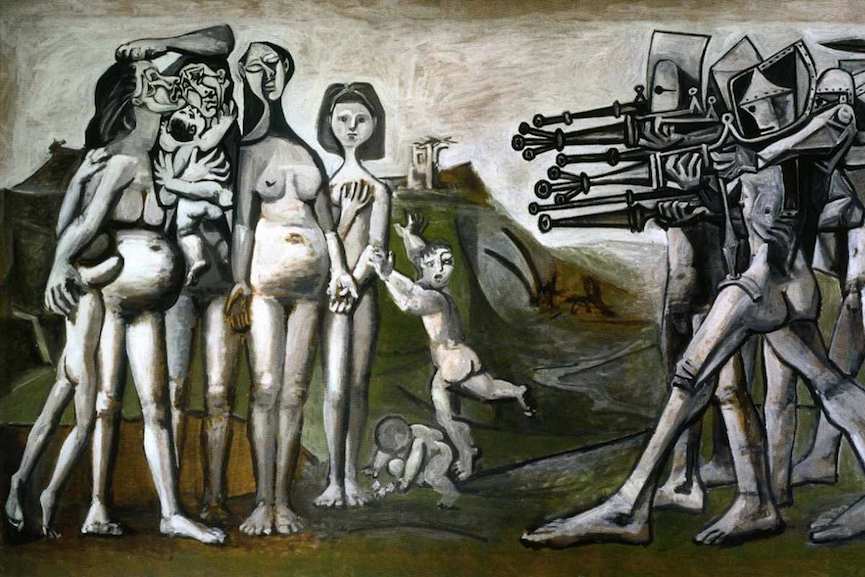
Pablo Picasso - Massacre in Korea  (1950) 

Modern man...
is now exposed to more images in a day
than anyone in the 14th century would have seen in their lifetime. 

Music is everywhere, attached to an ever growing array of  pitches for medical devices,
inexplicable pharmaceutical products with interminable lists of disastrous side effects,
and smiling sociopaths running for political orifices. The wealth of the arts is available to anyone with internet access. And there is quality available out there.
But you have to seriously seek it out.
Most of it is garbage.
Most of it needs excising.
Just like cleaning up stuff at home, we are tempted to keep things because we’re fearful that we might be missing something.
We are probably not.
We have to discard.
We have to throw things away & cleanse the doors of our perception.
The effort must be made to discern what is worth looking at, hearing, and remembering.
What are the images of relevance? What is music that matters?
What value will I retain from the art I consume?

Louis Isadore Kahn, the noted Philadelphia architect said
"The creation of art is not the fulfillment of a need, but the creation of a need.
 The world never needed Beethoven’s Fifth Symphony until he created it.
Now we could not live without it.”
It is the prerogative of art to make the world whole and comprehensible.
Music has the power to restore the world and allow us to glimpse it within ourselves in all its glory, mirth, sorrow, and occasional nastiness. As does visual art.

The arts tend to do this in ways other types of communication simply can not.
The music I love closes the gap between "me" and everything that is not "me".
It moves me in ways beyond transcendence.
The works of art I love do much the same.
There is a quality of recognition in there.
An awareness of connection.
Between the creation, the creator, & the observer.
When you see the ancient cave drawings, do you not know something of the person who created it?


The experience bounces from feeling to meaning.
It makes them whole, indiscernible from one another.
It's not something that committees can do.
 It's not a task achieved by groups or by movements.
It's done by individuals, each artist mediating in some way
between their sense of a history and their experience of the world.

Yet the arts have another function historically.
One that could or should be more evident today.
Decades age, art critic Robert Hughes made a note of this in his book "The Shock Of The New" -
“What has our culture lost in 1980 that the avant-garde had in 1890? Ebullience, idealism, confidence, the belief that there was plenty of territory to explore, and above all the sense that art, in the most disinterested and noble way, could find the necessary metaphors by which a radically changing culture could be explained to its inhabitants.”
It’s one thing to move someone with a work of art.
It’s another thing to mobilize them.
For centuries, artists have used their canvases, sculptures, films, and musical compositions to express their political views. Sometimes it's to offer a commentary,
sometimes it's to initiate real social or political change.

As we peer back with the advantage that hindsight yields it's easy to see the artists of Weimar Germany and Leninist Russia lived in a much more attenuated landscape of media than we do today. There was a reward in a way in that they could still believe, in good faith and without bombast, that art could morally influence the world. Today, the idea has largely been dismissed, as it must in a mass media society where art's principal social role is to be investment capital.
We still have political art, but we have no effective political art.
Perhaps the same can be said of satire.
Art and satire have been the greatest operational weapons against power historically.
Is it me? Or is have these arrows lost their sharpness?
In the 1960s, Country Joe & The Fish, a fine musical coterie in their own right, who also mixed acerbic satirical wit with their music, could arguably be said to have ended the Vietnam war with a song. 


Give me an F

Give me an I

Give me an S

Give me an H

What's that spell?

FISH!

What's that spell?

FISH!

What's that spell?

FISH!


Yeah, come on all of you big strong men
Uncle Sam needs your help again
He's got himself in a terrible jam
Way down yonder in Vietnam
So put down your books and pick up a gun
Whoopee! Going to have a whole lot of fun

And it's 1, 2, 3

What are we fighting for?

Don't ask me, I don't give a damn

Next stop is Vietnam

And it's 5, 6, 7

Open up the pearly gates

There ain't no time to wonder why

Whoopee!

We're all going to die

Well come on generals let's move fast 
Your big chance has come at last 
Got to go out and get those reds 
The only good Commie is the one who's dead 
And you know that peace can only be won 
When we've blown them all to kingdom come 

Well come on Wall Street don't move slow 
Why man, this is war-a-go-go 
There's plenty good money to be made 
By supplying the Army with the tools of the trade 
Just hope and pray that if they drop the bomb 
They drop it on the Viet Cong 

Well come on mothers throughout the land 
Pack your boys off to Vietnam 
Come on fathers don't hesitate 
Send them off before it's too late 
Be the first one on your block 
To have your boy come home in a box

The impact that song had on the nations psyche eventually, can not be overestimated.


As far as today's politics is concerned, most art aspires to the condition of Muzak.
It provides the background hum for power.
We are tempted to say...
We need another Country Joe & The Fish.
We need another Joe Strummer
We need another Goya.
We need another Picasso.
We need another Orwell.
But that's not it exactly, after all they owe us nothing.
We owe them a great deal. And history has it's role, but as an informant.
The past should not be repeated...not as a goal.
What we need is art that is EFFECTIVE politically.
Truth has a funny way of revealing itself eventually.
Democracy can be said to be "the least worst" way to organize a society.
And it has had a tendency to be crisis ridden.
Yet so far, democracy has emerged from each of it's illnesses almost in spite of itself.
It's downside is it never seems to see the crisis coming, let alone do anything to prevent it.
But in the last moment, it manages to act and live to die another day.
This survival skill must not be taken for granted.
Survival of one disease is no guarantee of survival of the next.
This is where political art may be crucial.
Actually stopping sabotage and disease before it reaches critical mass.

What is political art? Is it different than art?
Well, the ruling mechanisms over all aspects of humanity impact artists just like anyone else.
So for some,  reflecting deeply on this subject would be unavoidable...it's part of life.
 From its beginnings, art has been inseparable from the societies it was created in.
Throughout history authors have reflected their present moment,
bringing the artistic truth to the general public.

Sometimes an artistic truth is political truth as well.
For Plato and Aristotle, mimesis – the act of artistic creation
is inseparable from the notion of "real world", in which art represents or disputes the various models of beauty, truth, and the good within the society.
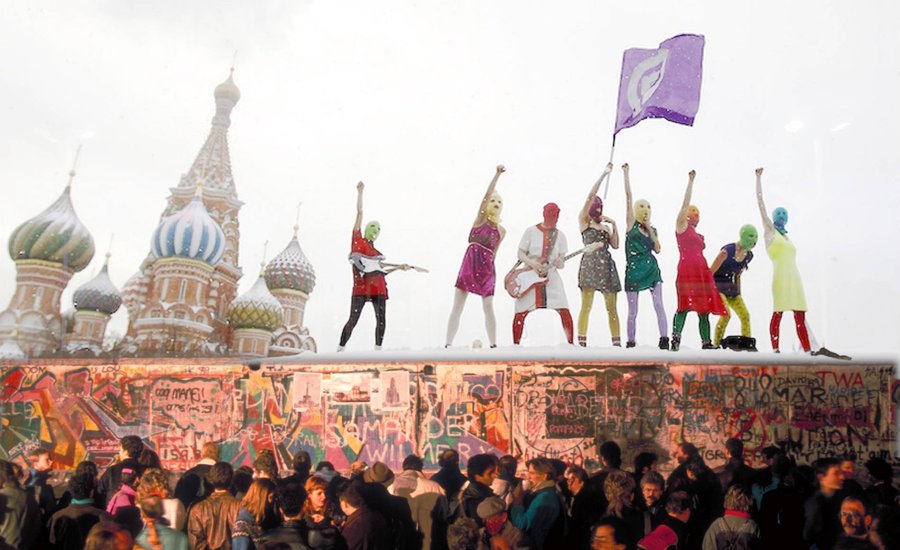
Pussy Riot

The aesthetic value of any work of art does not rise from the work's apparent ability to affect the future. Cézanne is not valued because of the Cubists who drew from him. Value rises from deep in the work itself. Music and art must possess a vitality, some intrinsic quality that resonates, addresses the senses, the intellect, and fires the imagination. If political art can meet that criteria, and if it's widely distributed or seen, I suggest it can change the world. 

World War I changed the narrative and images in art, radically and forever.
It brought our culture into the age of a mass-produced, industrialized death.
This, at first, was indescribable. Language failed.
But art succeeded. The music of the 20th century reflects all this,
the chaos, the horror, the hope & the fear. The Id, the ego, the 12 archetypes.
It's all there. Along with the uneasy acceptance of a quantum mechanical world.
Those who don't care for modern art simply don't care for the century it reflects perfectly.
And caring for it, finding beauty in it; is difficult I suppose. But the first law of art is contrast.
No dark without light. No resolutions without dissonance.
And that my friends is the point.
Muzak, and pretty landscapes have a place, a minimal one.
But real art is often disturbing on some level.
Neoclassicism and minimalism are frankly, a bore.
We gotta get out of this place!
Artistically...and politically.


Postscript-
Yes, yes, yes, I hear you...there ARE good artists doing good work.
I agree. But are they effective?
I'm not seeing it (hearing it).
The reasons they are not effective is fodder for some future post.
It has nothing to do with the quality of their work.
But maybe the methods of delivery to large audiences is simply no longer permitted.


Sunday, July 1, 2018

Face Facts : Democracy is out of the political equation, It’s been out of the equation for some time


Aghast at the churning subversion of political norms, the majority of Americans are witnessing institutions crumbling in the hands of a fetid, foul mouthed, flagrant liar in the role of   "Leader of the Free World". We stand, gape-jawed, as state legislators, following the president’s lead, refuse to condemn neo-Nazis, and children are taken from parents... sent to internment camps.
Meanwhile, nothing that Trump says or does seems to affect the loyalty of his base. Scandal after scandal, his approval rate hasn’t significantly budged. Forty percent of the population is consistently thrilled by Trump’s minority rules edicts. Whether it's anti-abortion, anti-gay, or anti-immigration policies, his supporters think he’s doing the Lord’s work!  As for that democracy thing, "good riddance. We never liked it anyways."

What a government claims itself to be, and how it operates, are not necessarily the same thing. Russia calls itself a democratic republic and recently“re-elected” Putin, but it functions as an oligarchic dictatorship. The National Socialist German Workers Party—the Nazi Party—was neither socialist nor pro-worker’s rights in any sense. It was fascist, supporting the merger of corporate interests with genocidal authoritarianism. The Democratic People’s Republic of Korea—North Korea—is neither a democracy or a republic. It is a dynastic dictatorship.
 In terms of political organization, despite the lofty words of the founders; the U.S. is neither a democracy nor a republic. It is an oligarchy.


If it walks like a dictator, quacks like a dictator, and holds the codes to a nuclear arsenal, it's a dictator.

In a true democracy, a fully enfranchised citizenry decides an election directly, with laws being enacted through a majority vote. In a republic, citizens elect representatives who vote on their behalf. But “voting on their behalf,” does not necessarily mean “voting according to their wishes.” Once in office, elected officials are not bound to faithfully represent the majority views of their constituents nor even the best interests of the nation, nor what benefits humanity. Decisions are "guided" by monied interests. So much so that corruption is routine and institutionalized. Want some law to benefit yourself, it only takes money going to the right place, and it's all perfectly legal.


The Native councils of Alaska unanimously opposed opening the Arctic Circle for oil drilling, protesting that it will damage the environment and irrevocably destroy their way of life. Alaska’s senior senator, Republican Lisa Murkowski, voted against their objections, clearing the way for theTrump administration to enact a law that opens the area for drilling.

Similarly, the tax reform bill of 2017 was historically unpopular, with less than 25 percent of all voters supporting it. In the end, because Republicans control the House, Senate, and Oval Office, a few dozen men overruled the wishes of 200 million Americans, and passed a bill that exacerbates an already catastrophic income inequality , while openly benefiting the extremely wealthy.

The U.S. is an oligarchy.

Under these conditions, the hollowing-out of the federal government is proceeding as planned.
Trump is no mastermind, but the journalistic interpretation of what is happening is consistently backwards, and that the “chaos” they speak of in the White House is, rather, the symptom of power being consolidated.

On some pathetic level, a Trump presidency makes sense, he an individual who rose to prominence because he embodied the unconscious truth of a particular moment.
The particular truth of our time is horribly ugly.

By logic, Trump should not be standing at all. And yet, there he IS.
Enabled by his father’s wealth to buy his way to prestige.
Enabled by banks to get out of unprecedented numbers of bankruptcies.
Enabled by the tax code to avoid paying taxes for at least 18 years.
Enabled by misogyny to repeatedly humiliate and assault women without consequence.
Enabled by credulity and ignorance to con the masses.
Those same masses—and the moguls of conservative media propaganda, who profit handsomely from despair—now want to see the world burn, and they want an insider to light the torch.
That’s Trump. Who better to understand the systemic moral failures of capitalism than the opportunist who has taken advantage of them for all 70 years of his existence?

Around the world, people WANT the economy to go to hell.
They WANT the cities to fall.
They WANT the catharsis of chaos.
The resentment is misguided and inchoate and will only hurt the meek, the poor, the huddled praised by the Psalms because theirs is the kingdom of Heaven. But this earth, not so much.


And so Trump won,* precisely because he doesn’t represent "We the People".
Inside a republic of consumers—this being the inevitable outcome of late-stage capitalism—he represents corporations-as-people, and dollar bills are the only votes that count.
The consequences of his administration are easy to predict.
It’s neofeudalism, where wealth and resources are concentrated in the hands of very few, and the disempowered grovel for crumbs.
There will be no more professional class, no bourgeoisie or educated “elites,” who are bothersome because they challenge theocratic hierarchies from within.
This cratering is already quite visible in Kansas and Oklahoma, where Republican-controlled governments have bankrupted their states, wreaking havoc among ordinary citizens who no longer have funds for public schools, repairing roads, or other public works. Make no mistake, these social disasters are not side effects of “pro-business” tax laws, but the obvious purpose of policies that favor a structural system enabling the wealthy oligarchy to gather more and more power.

The U.S. is an oligarchy.


* The caveat to Trump’s win, of course, is election meddling by Russia, which, among other things, used American social media to manipulate voters. Specifically, via Facebook, a firm called Cambridge Analytica accessed the private data of more than 50 million users, and used it to help elect Trump. “Facebook has styled itself as a neutral platform for information,” reporter Megha Rajagopalan wrote earlier this year. “But its role in spreading propaganda and fake news, as well as its relationship with government, shows how easily that neutrality can be exploited by autocrats.”
She was writing about Cambodia, but could easily have been written about many other countries including the U.S.

Back in 2010, The New Yorker ran a profile of Zuckerberg, who had a revealing exchange with another student. He told his friend that he had personal information on thousands of students at Harvard College thanks to his control of Facebook. Astonished, his friend asked “What?! How’d you manage that one?” Zuckerberg messaged back: “People just submitted it. I don’t know why. They trust me. Dumb fucks.”
Consider that Mark Zuckerberg is the fifth wealthiest person in the world, and Putin is rumored to be No. 1. Eliminate the nationalist frameworks, and suddenly it becomes obvious that the world’s wealthy want  foxes to run the henhouse. Between fanning the flames of division, planting ridiculous fake news stories that spread virally on social media, elections are rigged via gerrymandering, voter-suppresion -ID laws, & dark money
Despite losing by nearly 4 million votes, Trump won the election.
This is an Oligarchy.
It's not Russia per se that is meddling in elections, it's an international group of oligarchs.
The people who already own most everything.
It's not enough...it never is.
They want the EU to fail, they want more direct control of nation's governments.
They want organizations like the United Nations to disappear.
Dictatorships, you see, are orderly while democracies are messy and harder to control.
They've grown tired of the effort it takes to keep up the illusion of even a pseudo-democracy.

Why do you suppose the oligarchy hates collective bargaining and unions so much?
Yes, sure they seek to get labor as cheap as possible, but it's more than that. It's an obsession.
The Kochs, Mercers, DeVos & Murdochs of the world are organized against you.
And it's an advantage they want kept for themselves...they don't want YOU organized.