Showing posts with label economics. Show all posts

Friday, April 17, 2020

It Need Not Be Like This


Dum Spiro Spero.
 (While I breathe, I hope.)
We would do well, as George Orwell counselled us,
to see the traces of the dystopian world rising  around us,
to find the ends of those threads and how far along we are;
the most accurate prophecy being that people, and the allure of domination,
never really change.
We can build our future cities, make them as green and smart as we can, yet we are still embedded in systems that reward cronyism, exploitation and short-term profiteering, systems that require poverty and degradation, it will be mere camouflage. Dystopias will have cycle lanes and host World Cups.

What may save us is, in Orwell’s words, is
"a dedication to ‘common decency and the perpetual knowledge that it need not be like this.”


You Woke Up This Morning In A Cyberpunk World
The technology, surveillance, and dystopian  reality are obvious
—but it's it’s the culmination of decades of deliberate governmental erosion.


Where is the president in Blade Runner? Beneath the 1982 film based on Philip Dick's novel "Do Androids Dream Of Electric Sheep?"  beneath the neo-noir trappings of genetically engineered human automatons is a story about corporate power over and indifference to life.
A view of  alienation in the face of wealthy indifference to the plight of workers.
Replace the Tyrell Corporation with Amazon or Walmart and reframe the replicants as “essential services,” and suddenly you have a world of workers terrified that their jobs are inherently a death sentence—moving straight from fiction to reality.
 But while Blade Runner is set in the once-distant future of November 2019,  it's resonance is inescapable in so many ways:
Vast corporate power.
Persistent surveillance.
Life finding a way in a time of constant crisis.

Underlying the tale, but perhaps it's most salient feature: an inescapable, painful awareness of politics and of the presence or deliberate absence of government in daily life.

Government, as experienced for much of the 20th century, is largely absent
from the lives of characters in cyberpunk stories. Police are a durable feature,
but government services and functions beyond the security state are absent.
 Yet for all the aggressive visibility of politics in our daily lives, we’re on the cusp of the powerlessness of a cyberpunk future. Cyberpunk speaks to the present because the conditions that inspired cyberpunk remain largely unchanged.

 As the COVID-19 pandemic sweeps through the world, it collides with governments in the West that have spent decades deliberately shedding responsibility, power, and capability.
They have reduced themselves to little more than vestigial organs that coordinate public-private partnerships of civic responsibility.
This intentional gutting of the state began in earnest in the 1980s, and the science fiction of that time—the earliest texts of cyberpunk—imagines what happens when that process is complete.
Cyberpunk is a genre of vast corporate power and acute personal deprivation.
The technologies at the center of it are all means of control, control bought by the wealthy or broken by criminals. Where recourse is available, in whatever small way, it’s through direct actions.
In William Gibson’s Neuromancer, characters interact with the government
either through past military service or in the law literally made manifest in code.
Real power is reserved only for entrenched wealth.
For Bruce Sterling’s Islands in the Net, politics is visible
but is driven by corporations either bending states to their will
or actively routing around governance.

These dystopias are the logical culmination of a political project designed to fundamentally limit what government can do for people ...
 and expand what it can do for the wealthy.

 “Back in the 1980s, before movies and video games reduced the genre to a mass of unimaginative violence and dim body modification tropes, cyberpunk was the literary movement that was busy projecting our fears about rampant vulture capitalism, media oversaturation, and emerging computer networks into fictional futures,” writes Infinite Detail author and journalist Tim Maughan.
 The 2020s are, in a real, tangible sense, the conclusion of The Long 1980s. Writing in the 1980s, foundational cyberpunk authors were watching as leaders on both sides of the Atlantic pursued a set of political reforms collectively known as neoliberalism. Prioritizing competition in the market above all else, these reforms were fundamentally a political project, aimed at shrinking the public sphere and undoing the commitments to social welfare that had been made in the wake of the chaos, upheaval, and deprivation of the first half of the 20th century.
This neoliberal turn was a project of unmaking the state for individuals and communities and remaking it for capital.


Cyberpunk conjured a world at this end state of neoliberal reorganization.
Islands in the Net features drone warfare launched against data havens at the behest of corporations. In Blade Runner, the profit considerations of multinational companies determine worker personhood. There is more than a little of the Tyrell Corporation’s prudent life expectancy design in how corporations respond to worker protests over a lack of personal protective equipment.
Today, cyberpunk’s anticipated neoliberal end state is nothing more fanciful than life as we know it. What is remarkable is not that writers anticipated how the neoliberal turn would go,
but that 40 years and several international economic crises later, politicians still respond to these crises with solutions that prioritize markets over people.

In the United States, greatly decreasing state capacity has been an ongoing bipartisan project since 1981. Even the Affordable Care Act, itself the flagship bill of the furthest-left administration in the United States in a half-century, is fundamentally built around the market first, with the government obliging humans into participating in that market.
 It is easy to see health care markets warping into what we see in cyberpunk.
The genre is rich with augmented bodies and artificial limbs, available at a steep price—a privilege available to the ultrawealthy or for a tremendous debt that obliges the recipient to a benefactor. It is the promise of the best medical care known to history—and the least affordable means to get it.

 Hospitals across the United States are in bidding wars with wealthy enclaves, black market profiteers, Federal agencies like FEMA, and one another for a finite supply of protective equipment.
At every point where the supply chain is open to market incentives, companies built to prioritize profit exploit the absence of state control, bogarting lab test contracts
and protective mask production lines.

 Cyberpunk portrays a world dominated by an insulated wealthy elite,
catered to by exclusive services  offering premium versions of what governments once offered the public.
In 2019’s Alita: Battle Angel, itself a schlocky adaptation of 1990s cyberjunky manga Gunnm, the upper class literally lives in a floating city, where they receive monthly shipments of exceptional organs harvested from the underclass below.
It’s modern organ transplant disparities blasted to hyperbolic proportions.
 That disparity, extended to all aspects of life, is the end stage of a deliberate political process. Historian Nils Gilman describes this policy as a “plutocratic insurgency,” where the wealthy seek “to carve out de facto zones of autonomy for themselves by crippling the state’s ability to constrain their freedom of (economic) action.” The wealthy do this within elected office and outside it, spending some small portion of their fortunes to ensure politicians meet crises with tax cuts instead of rent freezes.


As the wealthy expand the space where they can act with impunity,
they are aided from below by entrepreneurs of crime. In the void where  governments once offered protection, financial support, and access to medicine instead thrives an alliance of the rich who believe themselves above the law and their accomplices willing to flout the law.
 What might it mean, say, to experience a pandemic knowing that many of the needed medical supplies are getting bought up for personal use by the ultrarich, or captured by the black market and auctioned off to the desperate?
And, more importantly, what happens next, when companies are free to take over functions that in a previous era would have been taken care of by the government?
Amazon’s logistics empire now gets headlines comparing it to the Red Cross, even as warehouse workers protest over lack of personal protective equipment.
While the state of Texas waited until March 31 to issue a stay-at-home order in the face of the pandemic, San Antonio–based H-E-B activated its own Emergency Operations Center on March 4. By contrast, the Pentagon is still waiting for direction on where to send its 2,000 ventilators.
 It is not hard to imagine that after the pandemic, the mishandling of federal resources will be used as a reason to surrender even more state capacity to private companies, which will leave the government even worse equipped to handle whatever crisis comes next.

A significant strategy of the plutocratic insurgency, as enabled by the neoliberal turn, is to intentionally eave the government ill-equipped for a shared crisis. Rationing once-public goods by wealth is a choice societies make, no matter how much market essentialists portray it as natural.
 It is the same logic that deems people ordering goods at home worthy of protection while denying protections to the workers preparing those deliveries.

It is a short hop, skip, and jump from corporations branding the whole of their workforce “essential services” to imagining a future, as envisioned by cartoonist Matt Lubchansky.

One of cyberpunk’s most durable spinoffs is steampunk, which transposes the technological ingenuity and exploration from the imagined near future to an alternate past, from the 21st to the late 19th century. Steam engines and fantastical contraptions aside, it is telling that the conventions of cyberpunk work seamlessly in the Gilded Age. Because  the 2020s are hardly the first era of unaccountable corporate power, or of deprivation and dehumanization in the name of markets and technological progress.

 Escaping a Gilded Age takes more than just clever protagonists who can outwit the cruelties and exploitations of the wealthy few. As insurmountable as the power of robber barons once seemed, cataclysm and political action brought the Gilded Age to a resounding end.

The inoculations against another Gilded Age are found far less in the works of cyberpunk and far more in the Works Progress Administration.

 Escaping a Gilded Age takes an active, collective politics, one that refuses to let governments hide behind algorithms or abdication of responsibility to the market. Without that political movement, we’re not just living in the prologue to a cyberpunk future. We’re living in the first chapter of a "cybourgeoisie"  dystopian reality.


Friday, March 6, 2020

The Toll Plaza On The Road To Ruin - Or - How The West Was Lost


After WWII, western democracies sought a system which joined nations that embraced the principle that  no human being was inherently more valuable than another, that all individuals should be equal before the law. The USA provided the necessary leadership in this group to stand against totalitarian governments. This system meant support for human rights and for the idea that, to the best of their ability, all people had a right to decide their own fate. In the U.S. that system meant laws at home that regulated business, provided basic social welfare, and promoted the infrastructure that sought to provide  an even handed access to opportunity for most citizens.
 It also meant that, overseas, we participated in agreements and military alliances to try to promote democracy and to keep fascism or other totalitarian methods of rule at bay.

That era is done. It's plated and it has a fork in it's back.
The truth is that America's post-WWII course was hugely popular with both Republicans and Democrats. After all, they had seen unregulated capitalism cause the Depression and fascism create the unprecedented horrors of WWII, and they were determined to use democratic government to prevent those things from happening again.
The side effect of these policies was that America's prosperity grew by leaps and bounds,
and so too did our influence and credibility among like nations.


 But there was always a group of people who hated the post-WWII order.
Businessmen in the Republican Party resented the idea that they could not do whatever the hell they wanted without government bureaucrats whining about minimum wages or other labor laws.
They despised being told they couldn't dump waste wherever they wanted without public safety concerns,  and they hated the taxes the newly active government required.
They sneered at postwar military alliances, believing that they cost too much money and that they limited America's ability to use its new leadership role in the world in ways that would funnel windfall profits to themselves.
Theirs was a strong-man vision of society rather than the rules-based one in which everyone was equal before the law. They believed that society's leaders should be unfettered to run the world as they saw fit and that government's role was to be a subservient agent for businessmen.
 In those most prosperous times, they had been a minority.

As time went on, the living memory of America before FDR faded (the United States was a far different country than it became after FDR.  Nearly a third of Americans had lived in poverty. A third of the country's homes had no running water, two-fifths lacked flushing toilets, and three-fifths lacked central heating. More than half of the nation's farm dwellings had no electricity and most African Americans still lived in the South, where racial segregation in schools and public accommodations were still the law) support for an inactive federal government grew. As living memory of Pre-FDR America faded, those who favored the "strongman" approach to society gathered more support until the 1980s when most all the New Deal regulations that protected labor, prevented foreign ownership of news media, and held monopolies and trusts in check were removed. The republican businessmen hated paying for labor, and they despised organized labor so when Reagan fired the Air Traffic Controllers for striking, it was a death knell for the power of unions.


This faction had managed to take over American government in the 1980s, and gradually purged from their ranks anyone who disagreed with them. For the past 3 decades, they have gutted government regulations and welfare legislation, slashed taxes, and neglected infrastructure.
Their policies hollow out the middle class as they use their wealth to purchase more power in government affairs. At the same time, they pour money into the military and increasingly call for war rather than negotiations to solve international crises. In this transformed demented new version of America, instead of our traditional democratic alliances, we are helping and praising totalitarians like Vladimir Putin in Russia, Recep Tayyip Erdogan in Turkey, Kim Jong Un in North Korea, Saudi Crown Prince Mohammed bin Salman. The current president publicly admires their strength in control of their populations. All of our recent ideological shifts have benefited them.


In this "post truth" era, it becomes more difficult with each passing day to learn the truth about the activities of governments and corporations, about the quality or value of products, or about the health of one's own place in the community or the economy.
In this brave new world
that has forgotten the lessons of the last century,
properties are institutional and abstract.
They are beyond your individual control.
Abstractions such as money, insurance policies, certificates of deposit, stocks, and shares bury the importance and value the mutual good or pleasures of family and community life.
These things are being replaced by commerce with impersonal self-interested suppliers
and a placeless citizenship . While we are not slaves in name, and cannot be carried to market and sold as somebody else's legal chattels, we are free only within narrow margins.  For all our talk about liberty and personal autonomy, there are fewer and fewer choices that we are free to make.
Oh sure, you can choose from a duopoly of corporate brands and a generic cereal.
You can choose which disinformation bubble pollutes your head.
But you can not choose quality in any sense.
Nor can you choose to not be a consumer.
Sales are it. There is nothing more...nothing else.
The Ferengi rules of acquisition have replaced the Bill of Rights.


The great enemy of freedom is the alignment of political power with wealth.
This alignment destroys the commonwealth - that is, the natural wealth of localities and the local economies of household, neighborhood, and community,  it destroys  the foundation and practical means through which democracy moves.

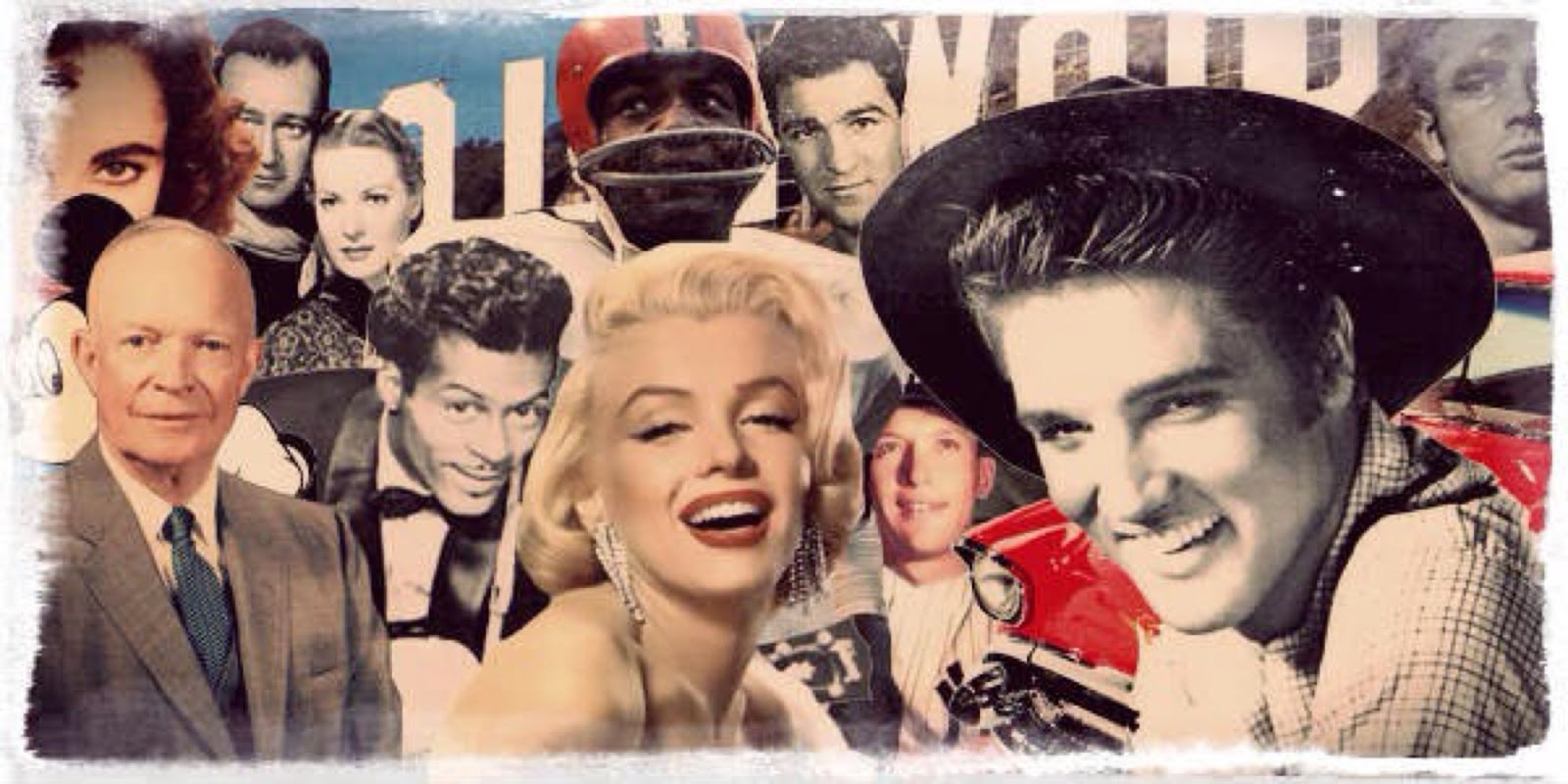
In the 1970s films like American Graffiti and television shows like “Happy Days” portrayed the 1950s as a carefree era--a decade of tail-finned Cadillacs, collegians stuffing themselves in phone booths, and innocent tranquility. 
There was a bit of that sort of charm yes,
but in truth, the post-World War II period was an era of intensity
 and of dynamic, creative changes.

During the 1950s, African Americans quickened the pace of the struggle for equality by challenging segregation in court. A new youth culture emerged with its own form of music--rock ‘n' roll.
In the 1960s that music became the amalgamate voice of a generation. The music industry in the 1970s generated far more money than all professional sports combined.
Alas, where there's money, corporate raiders wait in the wing to milk it dry.
This music became important precisely because it was not controlled... and once the corporate world  did take it over, consolidated it, and homogenized it... it died.
It had no more value. Not in the way it had previously.
That my friends is the metaphor.
This is what is happening to democracy.
It's been bought and sold. Out with the mutual prosperity and the experts!
In with the Businessmen focused on their personal gain and their sycophants.

Surely we do not need an ideology of any kind and can see ideologues are essentially cretins.
Well meaning or not.
But what we do need is heart, mind, common decency, and a rejection of the excess of individual greed over the common prosperity..."At Home And Abroad" as they once said.

Tuesday, July 9, 2019

...To Keep From Sinking Down


The world is at the crossroads.

While the social and political systems of the past lifted millions out of poverty and shaped our national and global policies were overall satisfactory in attaining certain goals, in the post industrial century they are failing us. One problem is antiquated laws that are ill-suited to deal with contemporary problems. What is needed today is a set of interconnected activities that have the goal of shifting the structures of our social and economic systems to succeed in the area where previous industrial revolutions have failed to deliver sustainable benefits to all citizens, including for our future generations.

Realistically, we face the task of understanding and governing 21st-century technologies with a 20th-century mindset and 19th-century institutions.

Improved living standards and well-being were not evenly distributed as the past industrial revolutions progressed. Today, as a result, the world continues to struggle with a range of challenges: median wages in advanced economies are stagnating or falling despite staggering economic growth for some,  developing economies are struggling to translate economic growth into broad-based, sustainable progress in living standards; and nearly one in 10 people live in extreme poverty unnecessarily .

The question posed is: what type of thinking, and what kind of institutions do we need, to create a world where everyone has the chance to benefit from the highest possible levels of human development?

While I can't answer that that question for you,
I can say with certainty,
that the mindsets, institutions, and practices of the past
are not the answer.

We need new thinking, and fresh proposals.
And we need this now.

Saturday, July 7, 2018

Democracy - For Sale To Highest Bidder?


Back in 2003, researchers at the Yerkes National Primate Research Center, Sarah Brosnan and Frans de Waal, who led the research team, found that capuchin monkeys respond negatively to inequality and injustice.

In the experiment, capuchins were motivated to perform a task when rewarded with a slice of cucumber, until they became aware that other monkeys were being rewarded with grapes.
When the primates became aware that partners were receiving better rewards for the same task, they became agitated, threw their cucumbers at the researchers, and refused to participate in the experiment.

Humans, who we might argue are at least as intelligent (well we MIGHT),  have similar reactions to injustice. Studies in employee behavior support the equity theory of motivation, showing that effort is tied to the perception that employees are  being treated fair and rewards are distributed equitably and justly, based on performance. When employees perceive that they are not rewarded for their efforts compared to others, they strive to achieve justice by either doing less work, obtaining salary increases, reducing the rewards of others, or leaving these jobs entirely.

In both human and primate examples, social comparisons drive dissatisfaction. People are generally willing to put up with minimal  rewards if those rewards are distributed equitably.
We would rather be collectively poor than treated unfairly.
In a recent OECD Study, the point is made that there is now widespread recognition that GDP measures or GDP per capita are misleading when it comes to understanding economic well-being.
What the study found was that household income, with a particular emphasis on income inequality was by far the truthful measure of a country's well being. It analyzed the distribution of household wealth across 28 countries, finding that wealth inequality is twice the level of income inequality on average.

The study also found that the wealthiest 10 percent of households hold 52 percent of total household wealth on average. By comparison, the 60 percent least wealthy households own little over 12 percent. The situation of inequality is worst in the United States.
In the US, the share of wealth held by the richest 10 percent of households stands at 79 percent.
 The bottom 60 percent of U.S. households only hold 2.4 percent of household wealth.

This inequality gap is also wide in Europe -10 percent of households control 68 percent of wealth in the Netherlands and 64 percent in Denmark. However in both countries, there are strong government investments in social programs. For instance even the poorest citizens have access to healthcare and education.

The United States leads the world in wealth inequality.
Inequality justified by performance isn't a problem. But the idea that one can get ahead and achieve  based solely on merit has become difficult to defend. Research from the Brookings Institution shows there is some minor opportunity for economic mobility at the middle of the economic ladder. (Middle-income kids have some opportunities to shape their own destinies, moving up or down in socioeconomic status)  Yet the middle class is shrinking. It grows smaller every day.
 Those born to wealthy parents stay wealthy, and those born to poor parents stay poor.
Wealthy families provide ample safety nets that allow their children to succeed, quite often despite very poor choices , little effort, and even behavior that; had they been born to a less wealthy parent, would have landed them in jail.

Conversely, poor families become a liability to even the most ambitious offspring.

This effect of parental income on a child’s income, which economists call “intergenerational earnings elasticity,” or IGE, is growing in the U.S. In a comparative analysis across countries, income inequality is correlated with high IGE, and the United States has fallen behind all other Western democracies in both. The “American dream” is now more realistically the “Canadian dream.”

The truth is, despite the misguided belief; "merit" has little to do with income.
Most wealth is simply inherited.
Oh sure, you can find some people who became wealthy because of their intellectual property, or hard work, or intelligent use of their own talents...but on the Forbes list of the world's 100 wealthiest people, only a half dozen or so did not inherit their wealth.

Education is often a mechanism for the transfer of wealth, as the wealthy can send their kids to the best private schools and most expensive colleges, and use their influence to secure high paying positions afterwards.  Yet, even among students at the same college, it is clear that the system favors  wealthier families. Take internships, for example. In the US, the norm has been for companies and organizations to offer unpaid internships, capitalizing on the free labor of a generation desperate for the experience that has become necessary to enter the workforce. But how can a middle class or poor person afford to live while working for free? They can not.

Wealthy families can pay for their summer housing, transportation expenses and even cover tuition so the internship can count for college credit. Yet, other students must work paid retail jobs over the summer to earn money for books and other college expenses. Their resumes can not look as impressive. And what about students who want to go to law school? Students whose families can afford to pay the $1,500 fee for LSAT preparatory courses have a clear advantage over those who cannot. These are but a few examples.


The U.S. Supreme Court’s decision in the Janus case surprised no one who pays attention to America’s highest judicial panel. Every analyst following the case expected the Supremes to rule against America’s public sector unions. And by a 5-4 margin, they did.

The impact from this decision? The Supreme Court’s decision in Janus will make the United States still more unequal.

The five justices who decided Janus never, of course, mentioned anything about inequality in their ruling that public sector unions cannot collect representational fees from the nonmembers they are legally required to represent. The Janus majority justices talked instead about protecting First Amendment rights. But that lofty philosophizing merely served as a convenient cover for the continuing assault on the basic human right to justice on the job.

This assault was an effort bankrolled over the years by a relentless gang of fiercely anti-union deep pockets and it has been remarkably effective.

Back in the 1950s, over a third of America’s workers belonged to unions.
And that statistic underplayed the actual extent of the nation’s trade union presence.
In the private sector, outside the South, unions represented over half the workforce in the decades  after World War II.

The workers unions didn’t represent in those years directly benefited as well from heavy trade union “density.” Nonunion employers simply couldn’t hire and keep workers unless they improved what they had to offer in pay and benefits.

The business pushback against union influence started picking up considerable momentum in the 1970s, then achieved critical mass in the 1980s with Ronald Reagan in the White House.

In 1981, Reagan fired and permanently replaced striking air traffic controllers.
Two major private sector employers, Phelps Dodge and International Paper, would soon follow Reagan’s example with their own striking unions. Other employers took notes.

This willingness to replace striking workers, historian Joseph McCartin has written, would reshape “the world of the modern workplace.” Strikes would now almost totally disappear from American labor relations. Strikes had given workers leverage. Without them, unions simply couldn’t effectively pressure employers to increase wages as productivity & profits grew.

Other assaults on worker rights aggravated labor’s growing marginality in America’s workplaces.
The nation’s labor laws — statutes meant to protect workers’ right to bargain collectively with their employer — were killed. 
Employers who violated these statutes no longer faced any significant liability.
The assaults took a toll. By 1983, union membership had dropped to 20.1 percent of America’s nonsupervisory workforce. In 2017, the federal Bureau of Labor Statistics reported only 10.7 percent of the nation’s employees carried union cards.

And these stats overplay the actual extent — in the private sector — of the trade union presence in 21st-century American life. In the mid-20th century, most all union members worked in the private sector. Today union members make up 34.4 percent of the public sector workforce and only 6.5 percent of workers in the private sector.
Nine states now have overall union member rates under 5 percent. In other words, over vast swatches of the American economic landscape, unions  barely exist at all.


What does exist in the United States today?
A level of income and wealth inequality not seen since the 1920s, another era of minimal union influence. The history of America’s past century paints a vividly clear picture: Inequality in America has increased in the years when unions have been at their weakest and decreased in the years when unions have been at their strongest.

For years, the conventional economic wisdom has blamed our contemporary extreme inequality on irreversible trends like advancing technologies and globalization. But this myth is no longer defended by mainstream economists. Recent mainstream research has emphasized how crucial a role union density plays in income and wealth distribution.

Researchers from the International Monetary Fund (of all places!) have examined the economic experiences of 20 developed nations between 1980 and 2010. Most all of these nations showed a declining union presence over the course of these years, with that decline severe in some nations — like the United States — and much less severe in others. What they found was declining union density was “strongly associated” with the growing share of national income going, within each nation, to the richest 10 percent of the population. “The decline in union density,” this IMF research indicates, “explains about 40 percent of the average increase in the top 10 percent of income share in our sample countries.”

Part of that growing income share of the already affluent reflects the lower wages of workers in nonunion workplaces. The de-unionization that “weakens earnings of middle- and low-income workers,” the IMF researchers explain, “necessarily increases” the income share of corporate executives and shareholders.

Another part of that growing top 10 percent income hoarding reflects the loss of influence over basic public policy decisions that average wage earners wielded when unions were stronger.
That shrinking influence leaves the wealthiest 10% in control of the the economic and political system, and they rig it in their favor.

Other global economic bodies — like the OECD, the official economic research agency of the developed world — have concluded that our current high levels of inequality do no society any good.

“By not addressing inequality,” OECD Secretary-General Angel GurrĂ­a has pronounced, “governments are cutting into the social fabric of their countries and hurting their long-term economic growth.”

Last year, trade union leaders from around the world descended on an OECD Ministerial Council Meeting in Paris to make the case that significant progress against inequality will only come when workers have the bargaining power to “benefit from structural and technological change.” along with the

The U.S. Supreme Court has totally ignored economic reality with its Janus decision.
Come to think of it, the U.S. government in it's efforts to appease the billionaire class since the 1980s, has ignored economic reality entirely.
As for the rest of us?
Unlike the SCOTUS...or the other branches of government...
We can’t afford to.


Postscript: 
The Rich do not always win...remember that.
The memory of the  triumph over plutocracy that created the American middle class must not be permitted to be extinguished. The future may appear to be bleak, and if we do not change the course we are on, it will be. However that is a matter of choice. We need not choose a bleak future.
We must not let others convince us there is no choice.
Recommended reading on the subject:
an analysis of how America went from a plutocracy to a more egalitarian society and back again.