Showing posts with label Trumpistan. Show all posts

Monday, July 2, 2018

The Irksome Method Of Demise


The techniques employed in the destruction of democracy in modern times have evolved.
No longer are the coups obvious overthrows or violent.
Rather, the preferred tactic today is for  elected leaders to subvert the very process that brought them to power.

 In Venezuela, Hugo Chávez was freely elected president, but he used his soaring popularity (and the country’s vast oil wealth) to tilt the playing field against opponents, packing the courts, blacklisting critics, bullying independent media, and eventually eliminating presidential term limits so that he could remain in power indefinitely.

In Hungary, Prime Minister Viktor Orbán used his party’s parliamentary majority to pack the judiciary with loyalists and rewrite the constitutional and electoral rules to weaken his opponents.

Elected leaders have similarly subverted democratic institutions in Ecuador, Georgia, Peru, the Philippines, Poland, Russia, Sri Lanka, Turkey, Ukraine, and elsewhere.
In these cases, there are no tanks in the streets. Constitutions and other nominally democratic institutions remain in place. People still vote. Elected autocrats maintain an illusion of democracy while eviscerating its substance entirely.
This is how most democracies die today: slowly, in barely visible steps.


How vulnerable is American democracy to such a fate?
Extremist demagogues emerge from time to time in all societies, even in healthy democracies.
An essential test of this kind of vulnerability isn’t whether such figures emerge but whether political leaders, and especially political parties, work to prevent them from gaining power.
When established political parties opportunistically invite extremists into their ranks, they subvert democracy.

Once a would-be authoritarian makes it to power, democracies face a second critical test: Will the autocratic leader subvert democratic institutions or be constrained by them?
Institutions alone are not enough to rein in elected autocrats.
Constitutions must be defended—by political parties and organized citizens,
but also by democratic norms, social contracts of rules of toleration and restraint.
Without robust norms, constitutional checks and balances do not serve as the bulwarks of democracy we'd like to imagine them to be.

Institutions become political weapons, wielded forcefully by those who control them against those who do not. This is how elected autocrats subvert democracy—packing and “weaponizing” the courts and other neutral agencies, buying off the media and the private sector (or bullying them into silence), and rewriting the rules of politics to permanently disadvantage their rivals. The tragic paradox of the electoral route to authoritarianism is that democracy’s enemies use the very institutions of democracy—gradually, subtly, and even legally—to kill it.


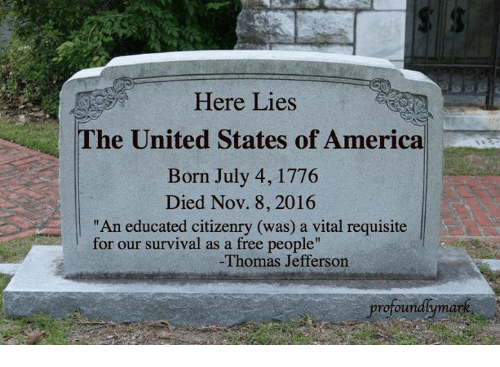
The United States failed the first test in November 2016, when it elected a president with no real allegiance to democracy whatsoever. Donald Trump’s surprise victory was made possible not only by public disaffection but also by the Republican Party’s failure to keep an extremist demagogue from gaining the nomination.

How serious a threat does that represent?
Many observers take comfort in the U.S. Constitution,
which was designed precisely to thwart and contain demagogues like Trump.
The Madison system of checks and balances has endured for more than two centuries.
It survived the Civil War, the Great Depression, the Cold War, and Watergate.
Surely, then, it must be able to survive the current president?


I am far less certain.
Democracies work best—and survive longer—when constitutions are reinforced by codes of mutual toleration and restraint in the exercise of power. For most of the twentieth century, these codes of conduct have functioned as the guardrails of American democracy, helping to avoid the kind of partisan fights-to-the-death that have destroyed democracies elsewhere in the world, including in Europe in the 1930s and South America in the 1960s and 1970s.
But those codes of conduct are now weakening...well they are obliterated actually.
When Barack Obama became president, many Republicans, abandoned their restraint for a strategy of winning by any means necessary. This included claiming that Hawaii was Kenya and making up absolute bullshit rules that prevented the president from nominating his pick for the SCOTUS.
That was a complete abuse of power.
 Donald Trump has accelerated this process, but he didn’t cause it.
The challenges we face run deeper than this one man, however troubling this one man might be.

There is a reason no extremist demagogue has won the presidency before 2016.
 (Extremist figures have long degraded the landscape of American politics, from Henry Ford,  Charles Coughlin, & Huey Long to Joseph McCarthy, Pat Robertson, and George Wallace).
But political parties have, in the past acted as filters against would-be authoritarians. They screen out those who pose a threat to democracy or are otherwise unfit to hold office.
This role has been obliterated.


America’s constitutional system of checks and balances was designed to prevent leaders from concentrating and abusing power, and for most of our history, it has succeeded. Abraham Lincoln’s concentration of power during the Civil War was reversed by the Supreme Court after the war ended. Richard Nixon’s illegal wiretapping, exposed after the 1972 Watergate break-in, triggered a high-profile congressional investigation and bipartisan pressure for a special prosecutor, which eventually forced his resignation in the face of certain impeachment. In these and other instances, our political institutions served as crucial bulwarks against authoritarian tendencies.

But constitutional safeguards, by themselves, aren’t enough to secure a democracy once an authoritarian is elected to power.
Even well-designed constitutions can fail. Germany’s 1919 Weimar constitution was designed by some of the country’s greatest legal minds. Its long-standing and highly regarded Rechtsstaat (“rule of law”) was considered by many as sufficient to prevent government abuse. But both the constitution and the Rechtsstaat dissolved rapidly in the face of Adolf Hitler’s rise to power in 1933.

Or consider the experience of postcolonial Latin America.
Many of the region’s newly independent republics modeled themselves directly on the United States, adopting  a U.S.style president, dual  legislatures, supreme courts, and in some cases, electoral colleges and federal systems.
Some wrote constitutions that were near-replicas of the U.S. Constitution. Yet nearly all the region’s embryonic republics plunged into civil war and dictatorship.
For example, Argentina’s 1853 constitution closely resembled ours: Two-thirds of its text was taken directly from the U.S. Constitution. Yet these constitutional arrangements did little to prevent fraudulent elections in the late nineteenth century, military coups in 1930 and 1943, and Perón’s populist autocracy.

Likewise, the Philippines’ 1935 constitution has been described by legal scholar Raul Pangalangan as a “faithful copy of the U.S. Constitution.” Drafted under U.S. colonial tutelage and approved by the U.S. Congress, the charter “provided a textbook example of liberal democracy,” with a separation of powers, a bill of rights, and a two-term limit in the presidency.
But what happened?
President Ferdinand Marcos, who was loath to step down when his second term ended, dispensed with it rather easily after declaring martial law in 1972.

If constitutional rules alone do not secure democracy, then what does?
Donald Trump is widely and correctly criticized for assaulting democratic norms.
 But Trump didn’t cause the problem. The erosion began decades ago.

Think about it, 25 years ago,  if someone had described to you a country where candidates threatened to lock up their rivals, political opponents accused the government of election fraud, and parties used their legislative majorities to steal Supreme Court seats, you might have thought of Ecuador or Romania.
 It wouldn’t have been the United States of America.

This is a slow irksome method of demise.


Thursday, June 28, 2018

The Minority Rules Era - Watching Democracy Die

We have a tendency to think of democracies dying at the hands of thugs with guns. During the Cold War, coups d’etat accounted for nearly three out of every four democratic breakdowns. 
Military coups toppled Egyptian President Mohammed Morsi in 2013 
and Thai Prime Minister Yingluck Shinawatra in 2014.  
So yes, in cases like these, democracy dissolves in spectacular fashion. 
Tanks roll in the streets.
Leaders are imprisoned or shipped off into exile.
Constitutions are tossed in the dustbins of history.
Yet the truth is, overt dictatorships have disappeared across much of the world.
Violent seizures of power are fairly rare.
But there’s another way to kill a democracy:
 not at the hands of generals, but of elected leaders
 who subvert the very process that brought them to power.

A minority group has seized overwhelming political, economic, & cultural dominance in the USA, despite representing a small fraction of the overall population.
Democrats have won the national vote in six of the last seven presidential elections, (only the 2nd Bush term was actually won, and this had more to do with the hysteria of a bogus "war"...Americans do not change presidents during wartime historically) which, with the retirement of Anthony Kennedy, will have resulted in the appointment of eight of the Supreme Court’s nine justices. And yet four of those justices will have been appointed by presidents who took office despite having fewer votes than their opponent.

Republicans have solidified control of the court’s majority with the chance to replace the sometimes-wavering Kennedy with a never-wavering lapdog ideologue.
It was during the Bush era that conservatives began spreading visual representations of the country-level vote. Flattened out, they displayed a sea of red, punctuated by small blue dots.
These blue dots are actually the areas where most people live. 
These maps, one of which Trump is known to display, create the illusion of popular support.
It's a dirty trick.
The illusion is created because of course, The red represents vast empty acreage rather than people.

And this is how the minority rules.
Over the last generation, the Republican Party has moved rapidly rightward, while the center of public opinion has not.
There is no substantive basis in public opinion for Republican government.
On health care, taxes, immigration, guns, the GOP has left America behind in its race to the far right. The Supreme Court underscores its ability to counteract the undertow of its deepening, unpopular extremism by marshaling countermajoritiarian power.


Harken back a moment with me,  it's December 2000. George W. Bush had a tenuous hold on the Electoral College, despite having half a million fewer votes nationwide.
But his electoral edge depended on a narrow margin in Florida, which was attributable to the fact that voting machines in Democratic counties failed to register a higher percentage of votes than machines in Republican counties. A recount threatened that outcome (and in fact, a hand count that included every kind of missed vote, including ballots that both wrote and checked in the name “Al Gore,” would have given the presidency to the Democrats). But Bush’s brother controlled the state’s government, and it doggedly refused to allow the recount to which the trailing candidate was entitled. In the end, five Republican Supreme Court justices narrowly ended the recount and gave Bush the presidency.
The importance of the role of the Supreme Court, as a fair & just body above the din of the temporary politics of the day can not be overstated. Historically, it has largely done just that.
But the political pressures placed on nominees is a different beast these days.
No one seems to give a damn about justice or what is actually constitutional.
Rather the emphasis is on how can the constitution be twisted to support an ideology.
A corrupted use of the SCOTUS would mean that since the legislative branch failed it's duties to protect the US constitution, nothing would stop the autocratic rule of the narcissistic demagogue the minority has placed in power. 


The House has a massive Republican tilt, requiring Democrats to win the national vote by six or seven points in order to secure a likely majority. The Senate has an even more pronounced tilt, over-representing residents of largely underpopulated rural areas.
George W. Bush in 2000 and Trump in 2016 each won 30 states while losing the national vote.
Since each of these states has equal representation in the Senate, the chamber gives Republicans an innate advantage. If the country were evenly split, half Democrats & half Republicans;  merely attaining parity requires Democrats to win at least ten seats in Republican-leaning states.

The Electoral College reflects the same overall bias. It reduces the power of voters who live in states that vote heavily for one candidate or the other, and magnifies the power of voters who live in closely balanced states, it gives disproportionate influence to rural white voters demographically speaking.
A state that may have voted 48% for a candidate, will turn those votes into votes for the opponent thanks to the "winner take all" method of tallying electoral votes 48 states use.
(This is largely why 'electoral votes' do not reflect actual votes.)

The Republicans have consciously leveraged this minority power.
Mitch McConnell’s indefensible claim that the Senate would not allow President Obama to pick a SCOTUS appointment in an election year, followed now by his shameless claim that this election year rule he'd made up no longer applies and is ridiculous. (Oh...yes it was...that much is so)


The Court’s near decision to destroy the Affordable Care Act previews the growing enthusiasm on the right for what legal scholar Jeffrey Rosen called “the Constitution in Exile.”
Even if Democrats gain an enduring advantage in elected office, large enough to overcome all the white and rural biases in the system, an activist conservative majority in the SCOTUS is hoped to strike down large segments of whatever they enact.

The central drama of the Trump era is a struggle to defend American democracy against an authoritarian leader. The Republican Party’s comfort with the crude authoritarianism of its president, did not spring up out of nowhere. It is the culmination of a party increasingly comfortable with, and reliant on, counter-majority power.
The Minority Rules.


Postlogue-
I don't like to frame my political observations as being related to political parties.
In the US historically these parties have stood for various things, sometimes quite the opposite of what they now represent. I'd much much rather use terms such as "liberal" and "left".
I'm proudly liberal despite the war waged against the word...well, words in general have been appropriated for politicization. Their meanings under attack.
To be clear, a Liberal imagines our world as it could be, pictures an optimistic future that is just, fair to all, and improves the lot of everyone. Then tries to make it happen.
This contrasts the Conservative who always points to the past & claims it was better, usually because of some privilege they had over others. They too try to make that happen.
 
 I have no fondness for the way our electoral process has come to work. Instead of discussing actual policies or issues and voting on them, we have a torturous 2 years worth of essentially spam promoting a "personality" being sold like some cereal product.
It's absurd, horrendously and unnecessarily costly.
Our democracy is something that has yet to be achieved.
It's a work in process, and there are saboteurs who hate democracy.
We certainly aren't there yet. But being "liberal" I see a future where democracy actually is practiced.
Where I have no more say than you, and you no more than me.
(Particularly where those who see themselves as having more 'rights' than others are legally and fairly kept from harming everyone else.)

In today's entry, I have had to talk about the political parties.
As I say I don't like to, but one party has gone way too far in it's extremism and antidemocratic actions. It is the role of congress to reign in the lawless personal exploitation of the presidency, and it has failed as an institution to do this. It has failed purposefully to uphold the constitution they swore to uphold. And this is the doings of one party, in complete control. The Republican party.
Whatever they once stood for, now, they are a disgrace...willing to do anything...ANYTHING for power. Even embracing fascism and kissing the filthy ass of a racketeering megalomaniac intent on robbing and raping the country for personal gain.
  Elections are not about individual candidates, they are about policies. Oh you may not care for either candidate in an election (I seldom do), but you better be able to discern what sort of policies their parties will enact. While I don't think the Democratic party is perfect, and I have reservations about some of their policies...most, I do agree with.  And though I'm not fond of putting a band-aid on a severe head wound...(I usually am pretty sure more needs to be done), I am certain pouring sulfuric acid  on it while singing Onward Christian Soldiers is not the way to go.

We may rightfully regret the electoral process is unfair, manipulated, corrupted, etc.
But this can not be an excuse to do nothing.
You must vote. And you must vote against Republicans.
The idea promoted that one party is just as bad as the other could not be any more drastically illustrated to be a lie than what you are witnessing right now.
Unlike the pervasive notion, it's not a personal popularity contest.
It's a war of ideas.
Good ones.
And very very bad ones.
If you were attacked by human eating giant squids from planet Falwell in a galaxy far far away, would you say " Gee I'd like to stop them, but I don't like the weapons I have to defend myself & family right now...I'll let someone else do it. But man, if I had better weapons I'd do something...yep, when I get the tools I ought to have..."
For now...vote.
Vote against the human eating squids.
That means vote blue.
Never give up the fight to make the world better, to make democracy work better, to improve...but don't be eaten by alien squids just because the improved world hasn't arrived yet.
Vote.
If your vote didn't count folks, do you think the Squids would be devoting so much time, energy & money to suppress it?
Vote, and vote blue.