Friday, March 6, 2020

The Toll Plaza On The Road To Ruin - Or - How The West Was Lost


After WWII, western democracies sought a system which joined nations that embraced the principle that  no human being was inherently more valuable than another, that all individuals should be equal before the law. The USA provided the necessary leadership in this group to stand against totalitarian governments. This system meant support for human rights and for the idea that, to the best of their ability, all people had a right to decide their own fate. In the U.S. that system meant laws at home that regulated business, provided basic social welfare, and promoted the infrastructure that sought to provide  an even handed access to opportunity for most citizens.
 It also meant that, overseas, we participated in agreements and military alliances to try to promote democracy and to keep fascism or other totalitarian methods of rule at bay.

That era is done. It's plated and it has a fork in it's back.
The truth is that America's post-WWII course was hugely popular with both Republicans and Democrats. After all, they had seen unregulated capitalism cause the Depression and fascism create the unprecedented horrors of WWII, and they were determined to use democratic government to prevent those things from happening again.
The side effect of these policies was that America's prosperity grew by leaps and bounds,
and so too did our influence and credibility among like nations.


 But there was always a group of people who hated the post-WWII order.
Businessmen in the Republican Party resented the idea that they could not do whatever the hell they wanted without government bureaucrats whining about minimum wages or other labor laws.
They despised being told they couldn't dump waste wherever they wanted without public safety concerns,  and they hated the taxes the newly active government required.
They sneered at postwar military alliances, believing that they cost too much money and that they limited America's ability to use its new leadership role in the world in ways that would funnel windfall profits to themselves.
Theirs was a strong-man vision of society rather than the rules-based one in which everyone was equal before the law. They believed that society's leaders should be unfettered to run the world as they saw fit and that government's role was to be a subservient agent for businessmen.
 In those most prosperous times, they had been a minority.

As time went on, the living memory of America before FDR faded (the United States was a far different country than it became after FDR.  Nearly a third of Americans had lived in poverty. A third of the country's homes had no running water, two-fifths lacked flushing toilets, and three-fifths lacked central heating. More than half of the nation's farm dwellings had no electricity and most African Americans still lived in the South, where racial segregation in schools and public accommodations were still the law) support for an inactive federal government grew. As living memory of Pre-FDR America faded, those who favored the "strongman" approach to society gathered more support until the 1980s when most all the New Deal regulations that protected labor, prevented foreign ownership of news media, and held monopolies and trusts in check were removed. The republican businessmen hated paying for labor, and they despised organized labor so when Reagan fired the Air Traffic Controllers for striking, it was a death knell for the power of unions.


This faction had managed to take over American government in the 1980s, and gradually purged from their ranks anyone who disagreed with them. For the past 3 decades, they have gutted government regulations and welfare legislation, slashed taxes, and neglected infrastructure.
Their policies hollow out the middle class as they use their wealth to purchase more power in government affairs. At the same time, they pour money into the military and increasingly call for war rather than negotiations to solve international crises. In this transformed demented new version of America, instead of our traditional democratic alliances, we are helping and praising totalitarians like Vladimir Putin in Russia, Recep Tayyip Erdogan in Turkey, Kim Jong Un in North Korea, Saudi Crown Prince Mohammed bin Salman. The current president publicly admires their strength in control of their populations. All of our recent ideological shifts have benefited them.


In this "post truth" era, it becomes more difficult with each passing day to learn the truth about the activities of governments and corporations, about the quality or value of products, or about the health of one's own place in the community or the economy.
In this brave new world
that has forgotten the lessons of the last century,
properties are institutional and abstract.
They are beyond your individual control.
Abstractions such as money, insurance policies, certificates of deposit, stocks, and shares bury the importance and value the mutual good or pleasures of family and community life.
These things are being replaced by commerce with impersonal self-interested suppliers
and a placeless citizenship . While we are not slaves in name, and cannot be carried to market and sold as somebody else's legal chattels, we are free only within narrow margins.  For all our talk about liberty and personal autonomy, there are fewer and fewer choices that we are free to make.
Oh sure, you can choose from a duopoly of corporate brands and a generic cereal.
You can choose which disinformation bubble pollutes your head.
But you can not choose quality in any sense.
Nor can you choose to not be a consumer.
Sales are it. There is nothing more...nothing else.
The Ferengi rules of acquisition have replaced the Bill of Rights.


The great enemy of freedom is the alignment of political power with wealth.
This alignment destroys the commonwealth - that is, the natural wealth of localities and the local economies of household, neighborhood, and community,  it destroys  the foundation and practical means through which democracy moves.

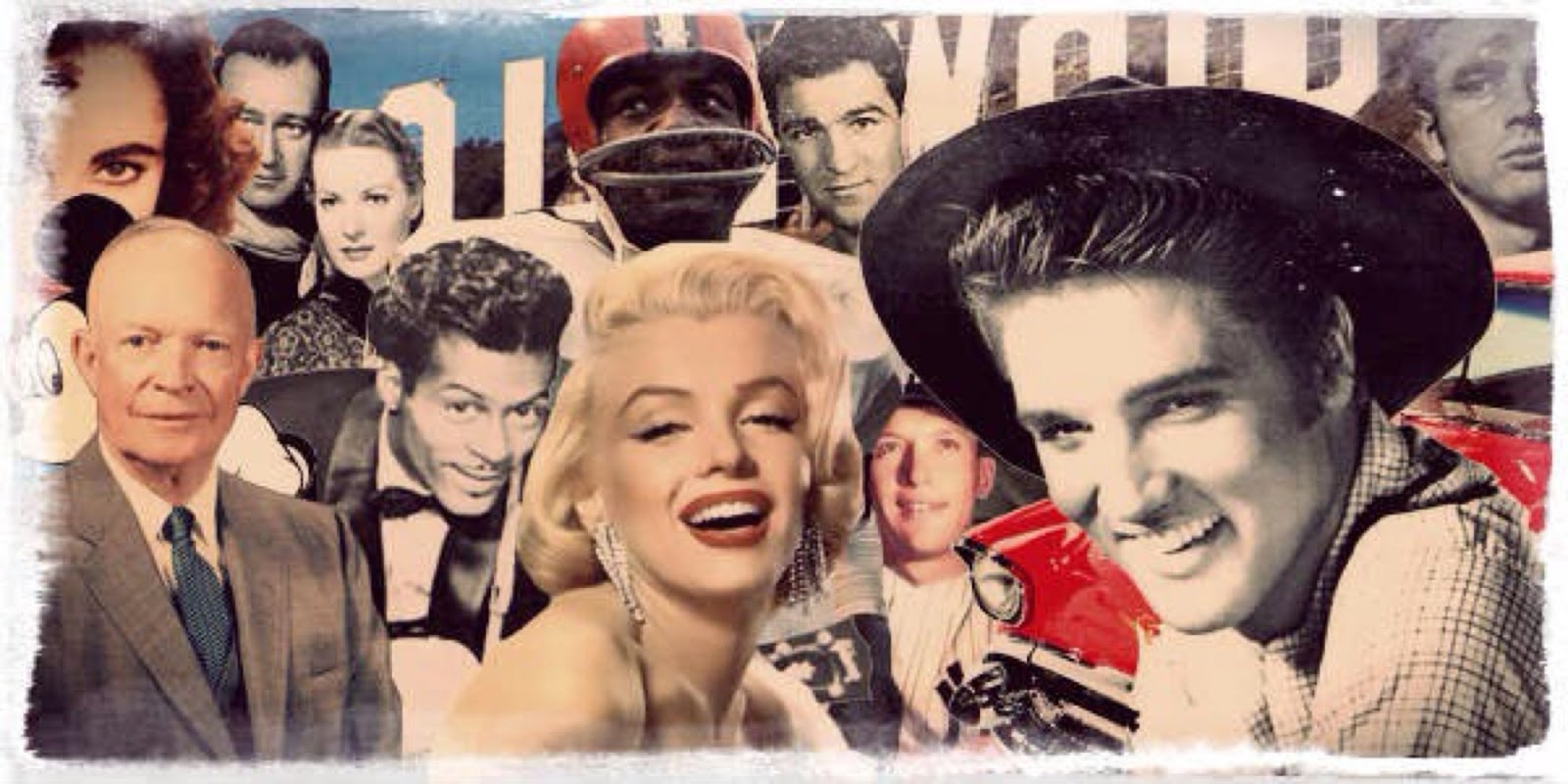
In the 1970s films like American Graffiti and television shows like “Happy Days” portrayed the 1950s as a carefree era--a decade of tail-finned Cadillacs, collegians stuffing themselves in phone booths, and innocent tranquility. 
There was a bit of that sort of charm yes,
but in truth, the post-World War II period was an era of intensity
 and of dynamic, creative changes.

During the 1950s, African Americans quickened the pace of the struggle for equality by challenging segregation in court. A new youth culture emerged with its own form of music--rock ‘n' roll.
In the 1960s that music became the amalgamate voice of a generation. The music industry in the 1970s generated far more money than all professional sports combined.
Alas, where there's money, corporate raiders wait in the wing to milk it dry.
This music became important precisely because it was not controlled... and once the corporate world  did take it over, consolidated it, and homogenized it... it died.
It had no more value. Not in the way it had previously.
That my friends is the metaphor.
This is what is happening to democracy.
It's been bought and sold. Out with the mutual prosperity and the experts!
In with the Businessmen focused on their personal gain and their sycophants.

Surely we do not need an ideology of any kind and can see ideologues are essentially cretins.
Well meaning or not.
But what we do need is heart, mind, common decency, and a rejection of the excess of individual greed over the common prosperity..."At Home And Abroad" as they once said.

Friday, February 28, 2020

No, A Businessman Is Not A Good Choice For President, And Government Is Not A Business


  Among the more misappropriated and indiscriminate expressions in the English language is saying that someone is “in business.” The pawnbroker, the accounts executive at CBS, and the musician busking on the street are all nominally engaged “in business,”. Cornelius Vanderbilt, P.T. Barnum, Bill Gates, Al Capone, and Charles Ponzi were all successful businessmen, but that fact obscures the differences in their daily affairs rather than reveals any fundamental similarities.


ROBBER BARONS


The term robber baron is originally German. It was used to describe feudal lords who charged nominally illegal tolls (unauthorized by the Holy Roman Emperor) on the primitive roads crossing their lands or larger tolls along the Rhine river. The American Robber Barons were titanic monopolists who crushed competitors, rigged markets, and corrupted government.
In their greed and lust for power, they held sway over a helpless democracy. Author & history professor  Hal Bridges said that the term represented the idea that "business leaders in the United States from about 1865 to 1900 were, on the whole, a set of avaricious rascals who habitually cheated and robbed investors and consumers, corrupted government, fought ruthlessly among themselves, and in general carried on predatory activities comparable to those of the robber barons of medieval Europe." The term combines the pejorative senses of criminal ("robber") and aristocrat ("barons" having no legitimate role in a republic). One thing is for certain. These types of people are harmful to democracy.  They are it's foes...not it's friends... and are always at odds with the very nature of fairness, justice, and all other democratic principles. Self interest drives business, even small benign business...and this is not conducive to public service.


Most U.S. presidents have had some experience in private enterprises before entering the Oval Office, a few of them quite substantial. Herbert Hoover made millions as a mining consultant; Jimmy Carter managed a successful peanut farm; and George W. Bush ran an oil company. However, no president before Trump has ever spent his entire adult life immersed in the hustle and huckstering of business or, to use Trump’s preferred nomenclature, deal-making. That activity deserves a special scrutiny in light of the refusal to release his tax returns. Conflicts of interests come in many forms, but few are as worrisome as the leader of the free world keeping one eye on his portfolio whenever he contemplates some national or international policy decision. The founders were clear about emoluments and of course it turns out the majority in power these days are not inclined to follow the constitution on this. They say Trump is a special case and allow him to continue profiting from his office; a clear constitutional violation. In fact, Donald Trump is the 10th highest paid "athlete" in the world based on the money he rakes in everytime he bilks the government for his golf trips.
No, we don't need a "businessman" to run the country. This is a common but idiotic notion that stems from the misguided belief that the president is essentially the nation’s CEO, a common misconception that warps one’s understanding of how exactly the federal government works constitutionally.

Americans are willing to overlook the opportunities for cronyism and self-dealing in a trade off for their mistaken belief that spending time “in business” is ideal training for being the commander-in-chief.
Instead of an obvious and (as far as the Founders were concerned) highly desirable consequence of the division of powers and divided government providing checks and balances,
Washington’s inability to “get things done” is seen as unmistakable evidence of gross deficits in the character and competency of its leaders.
If the president, in particular, were simply more technically gifted, managerially adroit, and decisive in his decision-making—in other words, if he had the skills we often associate with successful CEOs—Washington would at last “work,” a remarkable conclusion that assumes for one thing that Americans are unanimous about the “work” that they would like to see done.
The truth is far from this.


The head honcho of a Fortune 500 company may assume their orders will be dispatched faithfully by subordinates, but when dealing with members of Congress, a president’s power is by and large confined to the power of persuasion. Yes, the president does have a limited battery of carrots and sticks—the promise of a political appointment, for example, or the threat of withholding support in the case of a primary—but for the most part, when one can neither freely promote nor fire the individuals one must work with in order to get anything substantial accomplished, they are power centers unto themselves rather than pawns to be moved at will as in businesses.

Ironically we have a casino magnate with six bankruptcies under his belt
who is playing high-stakes poker.
Domestically, he's playing with house money.
Overseas, he gambles with blood...not his own.
The question is " how did we get to this low station?"

THIS LOW STATION

After the rise of the Robber Barons in the gilded age, Trust Busting Teddy Roosevelt accomplished a great deal towards diminishing the oligarchic practices of big business. FDR made further strides. And things were going well generally in terms of general democratic practices in the US.

But sadly, in 1980, Ronald Reagan won the White House by arguing that the New Deal, the laws that regulated business, provided a basic social safety net, and promoted infrastructure, were destroying American liberty. In his inaugural address, Reagan claimed “Government is not the solution to our problem;” “government is the problem.” 
And the sheep believed him. 


America now turned for solutions, not to educated experts informing government policy,
but rather to individuals who claimed to be outside that sphere of expertise
- The business men...men of the people.
As the sheep celebrated those “self-made” individualists
the Congress cut taxes and regulation to free them to run their businesses however they saw fit.
We had a Republican house speaker who got into politics because he had been in the exterminator business and was angry about the government telling him he couldn't just dump his poisonous chemicals down the sink.

After 1981, wealth began to move upward at a startling pace , and yet the Republican party continued to howl about socialism and insisted that we would not have true freedom until all regulations, all taxes, and government programs that did not enrich the already wealthy were destroyed. 
When Reagan came into office in January of 1981, the top tax rate was 70%, but when he left office in 1989 the top tax rate was down to only 28%.
As Reagan gave the breaks to all his rich friends, the lack of revenue coming into the federal government caused huge deficits. The national debt,  when Reagan came into office
was $900 billion, by the time he left the national debt had tripled to $2.8 trillion.
In order to bring money back into the government, Reagan was forced to raise taxes eleven times always hitting the working class and poor the hardest.
The american labor unions were neutered under this presidency.
In their place we would have businessmen who had proven their worth by creating successful businesses. They would run our country in the best way for all of us. The claim that this system worked well or worked at all for any but the very few directly profiting from it is fiction. . Republican leaders stayed in power not because a majority of voters agreed with their ideology, but because as their policies moved wealth upward into the few and hurt most everyone else. The wealthy blamed economic hardships of the workers and middle class on women, minorities, immigrants and “special interests” who were demanding hardworking white men pay more taxes than they should. They also increasingly buggared the political system to make sure they stayed in power. They disenfranchised Democratic voters and carved up districts so that in 2012, for example, Democrats won a majority of 1.4 million votes for candidates to the House of Representatives, and yet Republicans came away with a 33-seat majority. Trump lost the popular vote by OVER 3 Million votes but because of the arcane way states send electors to the electoral college...well you know the result. We place blame on the electoral college, but 47 of the 50 states choose to use a "winner takes all" regarding electoral votes. If they did not do this, if they submitted their electors in a way that actually reflected the votes in their state; the electoral votes would be similar to the popular vote count. While changing the constitution to get rid of the electoral college is a formidable task unlikely to happen, getting states to agree to delegate their electors based on the actual votes in their state is reasonable and practical.
Why do we not pursue this? (That's a question for a different posting I imagine.)

The election of Donald Trump
is the apex of this erroneous political mentality.

He was seen as an outsider who posed as a successful businessman, disdainful of politics, who promised to gut government (the swamp) and put into office only the best people, people known for their business or their family connections to other business sybarites. Expertise and loyalty to the American government was frowned upon.What mattered was the ability to make money and be loyal to the president. 
T
rump, like his predecessors slashed regulations, gave away national resources to businessmen, and passed a huge tax cut for the wealthy, a tax cut which was supposed to stimulate investment in the economy and promote economic growth. In the midst of the myriad of growing administration scandals, Trump banked on the fact that Wall St. profits would keep him in office for a second term and insisted that those opposing his administration, regardless of party, were hostile Democrats who wanted big government “socialism.”

Now, a virus from China is exposing the hollowness of a generation of relying on businessmen to manage our government instead of experts. The whole anti science mantra is exposed for the absurd charlatanism that it is. The administration’s response to the coronavirus has been disturbingly poor.

In 2018, it got rid of the government leadership for handling a pandemic, so we have no one in charge who is trained to handle such a crisis. Then, when the virus broke out, the Center for Disease Control and Prevention insisted on developing its own test, rather than using the guidelines established by the World Health Organization. Their test didn’t work, making health officials unable to test people in danger before they got sick. Then, over the advice of the CDC, administration officials decided to evacuate 14 infected patients who had been stranded on a cruise ship in Japan along with healthy travelers. We learned from a whistleblower that, once landed in the U.S., workers came and went from the facility that housed the patients with no precautions. Now, we have our first case of the coronavirus that appears to have appeared here on its own, and it happened in the same place where these workers came and went (although it is too early to say if there is definitely a connection,,,it would surely appear likely).
 
 Treasury Secretary Steven Mnuchin and Director of the National Economic Council Larry Kudlow, Trump's appointees for handling the Corona virus
(instead of people with expertise or science -medical backgrounds),
insisted on television that the virus is “contained.”

The problem of handling a public health crisis of this magnitude when you are merely equipped to promote business is demonstrated by Secretary of Health and Human Services Alexander Azar, a former drug company executive and pharmaceutical lobbyist, telling Congress that when scientists manage to make a vaccine for the coronavirus (12 to 18 months out, by all accounts), not everyone will be able to afford it. “We would want to ensure that we work to make it affordable, but we can’t control that price" This is the modern Republican Party laid bare. Profits before lives, because only businessmen, not government policy, can manage the country. This moment makes it really clear what happens when the Republicans’ ideology comes up against reality. While GOP leaders over the years, and Trump of late, have managed to silence opponents by calling them socialists or making sure they cannot vote, this virus is not going to stop simply by changing the narrative on twitter or Fox News. Investors know this, and the dropping stock market shows their realization that you cannot shut down entire countries and keep supply chains and consumer goods moving. The stock market has fallen 11.13% in the past four days, erasing a third of the gains it has made since Trump was elected. We are facing an economic downturn, one that will strain an economy that was excellent indeed for those at the very top, but not good for those who now will be vital to keep consumption levels up because but those very people will struggle to come up with extra income in an economic downturn.

The markets are acknowledging the biggest drops since the 2008 crisis. This is a crisis that demands expertise and coordinated government health programs, but we no longer have those things. Instead, Trump and his surrogates on the Fox News Channel are falling back on the old arguments that have worked so well for GOP leaders in the past: "Democrats are hyping the coronavirus and spooking the markets to hurt the president."

Trump, and Americans in general, are about to discover that there comes a point when hokum and product image can no longer override reality. We are in the spiral of that chaos now. But on the other side of it, we have the potential to rebuild a government that operates in reality, and that works for all of us.

While Americans need to reject this notion that business men will fix democracy.
We must also understand that Trump is the symptom of an infection  much deeper.
The corrupting effect money has on governance.
Imagine if you can a world where public servants spent their time serving the public instead of endlessly fund raising and campaigning or sucking up to corporate donors & oligarchs. Imagine policy makers who did not owe favors to the wealthy. An electorate not bombarded with ridiculous negative advertising from shadow organizations. None of this is good for democracy. None of this is good for anyone but the very few directly
benefiting  from such corruption.
We need to eliminate private money from the election process. Plain and simple.
Replacing an ignorant illiterate billionaire oligarch with a literate one is no answer. 
It's like taking an Advil to ward off cancer.  It just won't work.
Whoever is nominated to be the alternative to Trump's lies
has an awful big workload ahead of them
but not much else will matter if the importance of
private money in public policy making is not removed.

Public financing only. 
And campaigning should be limited to 2 months before an election. 
Attempting to influence elections or politicians through bribery
should be a serious criminal offense...not an institution.


Sunday, February 2, 2020

Social Media Is Killing Democracy


In Brazil, a crowd of supporters of the far-right president, Jair Bolsonaro began a surprising chant. They weren’t cheering for Bolsonaro or his running mate or their party; instead, they were reciting the names of social media platforms. “Facebook, Facebook, Facebook!” the crowd yelled. “WhatsApp, WhatsApp, WhatsApp!” They were crediting the platforms with their victory, and they were not entirely wrong. During that campaign, a conservative pro-business interest group funded a massive disinformation campaign on WhatsApp (the popular messaging app owned by Facebook).

Damaging and false information about Bolsonaro’s left-wing opponent, included fake news mocked up to look like neutral fact-checks, spread like wildfire in the runup to the October 8 vote.
This deluge,  played a large role in Bolsonaro’s victory. The glee Bolsonaro’s supporters exhibited points to a troubling development, one that SHOULD be familiar to Americans: Social media, once seen as a profoundly democratic technology, is increasingly serving the needs of authoritarians and their allies. Many observers have noted that entrenched authoritarian states, like Russia and China, have gotten very good at manipulating these platforms to marginalize domestic dissidents and destabilize democracies abroad. What’s gotten less attention is how authoritarian factions inside democratic states — far-right politicians and parties that are at best indifferent to democracy, benefit from the nature of modern social media platforms. Authoritarians of  all sorts benefit from spreading falsehoods about their opponents, they create panics about minority groups, and undermine people’s trust in credible independent media. Both the 2016 US election and the 2018 Brazilian vote proved social media is a perfect cheap tool for manipulating an increasingly gullible public.

Social media has the potential to help pro-democracy movements at times, but these platforms  overall serve far-right extremists and authoritarians.  Once seen as democracy’s ally, these platforms have increasingly become its enemy.


Why?

 It is easier to spread misinformation on social media than to correct it.
It is easier to inflame social divisions than to mend them.
The very nature of how we engage with Facebook and the rest now helps far-right, authoritarian factions weaken the foundations of democratic systems — and give themselves an easier pathway to seizing power. This is the unfortunate and sad uncomfortable truth:
Social media, in the way that it exists at this moment, is an authoritarian medium.

Ronald Deibert, a political scientist and director of the University of Toronto’s tech-focused Citizen Lab wrote in the The Journal of Democracy (one of the premier academic venues for analyzing the current state of democratic politics). “It seems undeniable, that social media must bear some of the blame for the descent into neo-fascism.”

In 2009, Iranians rose up to protest against a rigged election, the so-called “Green Movement” using Facebook and YouTube clips of protests to spread their message globally. Two years later, the Arab Spring protests showed the true power of these mediums, as protest movements that made skillful use of social media for coordination and messaging toppled regimes in Tunisia and Egypt.
At that time, the consensus among observers was that social media was, by its very nature, democratizing. Social media facilitates the swift spread of information, allowing citizens to get around government censorship. Social media allows rapid communication among large groups of disparate people, giving citizen activists new tools for organizing actions.
We had every reason to believe the spread of social media would necessarily weaken authoritarian states and strengthen democracies.

This theory turned out to be partly true: It can be difficult to simply repress the spread of information on social media. But as we’ve come to discover, it’s even more difficult to repress the spread of disinformation.

A savvy person or political party looking to discredit online critics doesn’t need to ban their speech to disable it. Instead, they can create a deluge of false or misleading information, making it very hard for ordinary citizens to figure out what’s actually going on.

Deibert’s essay usefully summarizes a number of different studies documenting how well the twisted jiujitsu of misinformation and information overload works:


An always-on, real-time information tsunami creates the perfect environment for the spread of falsehoods, conspiracy theories, rumors, and “leaks.” Unsubstantiated claims and narratives go viral while fact-checking efforts struggle to keep up. Members of the public, including researchers and investigative journalists, may not have the expertise, tools, or time to verify claims. By the time they do, the falsehoods have already embedded themselves in the collective consciousness.

Meanwhile, freshly baked scandals and outlandish claims are continuously raining down on users, mixing fact with fiction. Worse yet, studies have found that attempts “to quash rumors through direct refutation facilitates their diffusion by increasing fluency.” In other words, efforts to correct falsehoods can ironically contribute to their further propagation and even acceptance.
The constant bombardment of tainted leaks, conspiracy theories, and other misinformation in turn fuels public cynicism, with citizens growing fatigued as they try to discern objective truth amid the flood of news. Questioning the integrity of all media — one aim of authoritarianism — can in turn lead to a kind of fatalism and paralysis.

The WhatsApp propaganda in Brazil is one example of the effect Deibert is talking about. A well-funded campaign to spread false information was extremely difficult for Bolsonaro’s opponents and Brazil’s independent press to expose or discredit. The falsehoods these messages spread likely became truth in the eyes of a significant percentage of people who encountered them, many of whom would never see rebuttals and wouldn’t believe them if they did.

Donald Trump and his allies in the more unscrupulous parts of the American conservative movement employ a similar strategy. The president lies, a lot; while the mainstream press debunks him, right-wing outlets spread those falsehoods or manufactured supporting evidence on social media, where these lies cement as fact in the eyes of the president’s hardcore supporters.

Even my feed this morning was full of junk news going viral, claims that the whistleblower in the Ukraine scandal was identified (Absolutely untrue) and thanks to photoshop, was posing with all the democrats involved in the impeachment...that Adam Schiff was some sort of pedaphile (Quickly and easily debunked, but it won't matter...people who want to believe that, saw the posts, spread them further amongst their groups and no amount of fact checking will matter to them...it's now part of their mythology...their belief system.)

A recent study found that conservatives were more than four times as likely to share fake news on Facebook as liberals. Another study, from researchers at the University of Oxford, found that conservative users were overwhelmingly more likely to spread “junk news” (defined as outlets that “deliberately publish misleading, deceptive or incorrect information”).
“On Twitter, a network of Trump supporters consumes the largest volume of junk news, and junk news is the largest proportion of news links they share,” the Oxford researchers write. “Extreme hard right Facebook pages share more junk news than all other audiences put together.”


The phenomenon goes  far beyond the US and Brazil.
The far right has made huge inroads through most of Europe.
Marie Le Pen, and actual unabashed fascist very nearly won the French Presidency...and may yet win in the next election. The rise of the Tories and Brexit in England. Fascists rising even in the post-fascist nations of Germany and Italy where we once thought it would not be possible.
The Philippines’ Rodrigo Duterte cultivated an online fan base — even bringing popular social media influencers into his government — that’s known for “patriotic trolling”: sending hate messages to his critics and spreading smears about them. The Philippine news site Rappler identified a network of more than 12 million pro-Duterte propaganda accounts on various platforms, reporting that, led to a concerted smear campaign against the site from Duterte’s fans. An #UnfollowRappler social media campaign cost the site tens of thousands of  followers, a huge hit for an online publication that depends on clicks to stay profitable.

Social media isn’t the only reason far-right populists have been able to win elections.
There are all sorts of other reasons, ranging from ethnic divisions to economic injustice to anxiety about crime or the weakness of the political opposition that these leaders have exploited in their rise to power. While it would be absurd to blame technology for this phenomenon, it would be equally absurd to ignore it's role.  The global challenge to democracy from within isn’t social media’s fault, yet the major platforms do seem to be making the crisis worse. The platforms by their nature allow far-right politicians to marginalize opponents, consolidate their base, and exacerbate the social divisions that helped them rise to power.

Russia’s Internet Research Agency (often abbreviated to IRA) has been a formidable troll factory for the Kremlin. It has displayed a mastery of postmodern disinformation techniques for fomenting polarisation, distrust and confusion in target populations of social media users.
 The New Knowledge report studied 10.4m tweets, 1,100 YouTube videos, 116,000 Instagram posts, and 61,500 unique Facebook posts published from 2015 to the end of 2017.
It found that the IRA created social media accounts under fake names on every available platform – not just Facebook and Twitter, but also Instagram, YouTube, Reddit, Tumblr, Pinterest, Vine and Google+. One of the most surprising revelations was the extent to which the IRA used Instagram to sow distrust and discord, which suggests that Russian trolls have a good working knowledge of western hipsterdom. Aside from polluting the minds of partisans, even the most reasonable sincere citizen, devoid of political affiliations; is bombarded with so much junk 'news' that eventually they disengage to protect their sanity.
Make no mistake, the Russian troll factory is hard at work right now as you read this. Their successes globally in 2016 and 2018, and the acceptance, even welcoming; of this interference by the hard right factions and even the US Senate, has emboldened not only Russia, but China, Iran, Turkey, the Saudi murderous regime, as well as North Korea to step up their trolling operations.

 RenÃĐe DiResta, one of the lead researchers in the study, had this to say: “In official statements to Congress, tech executives have said that they found it beyond their capabilities to assess whether Russia created content intended to discourage anyone from voting.
We have determined that Russia did create such content.
It propagated lies about voting rules and processes,
attempted to steer voters toward third-party candidates
and created stories that advocated not voting.”

 What does all this mean?

It means that the world has changed, and that democracies are in a new ballgame.
Manipulation of  media environment by foreign as well as domestic dishonest actors is now the new normal.
If anything has changed since 2016, it’s that social media is no longer seen as just a useful tool for influencing elections. It’s now the terrain on which the entirety of political culture rests, whose peaks and valleys shape the everyday discourse, and whose possibilities for exploitation are endless.
Until we either secure that ground or replace it entirely, we should expect many more attacks, each one in a slightly different form, and each leaving us with even more doubt that what we see reflects reality.  Or, to put it more succinctly: social media poses an existential threat to the kind of liberal democracy we like to think we have.


There is an urgent need to gain a deeper understanding of the widespread decline of democracy and the unnerving movement toward dictatorship in the 21st century.
We are confronted by serious and unexpected challenges to our freedoms and human rights.
By the end of this century, the United States, the European Union, and other societies that are at present relatively open may be overtaken economically and or militarily by China and other dictatorships. Closed societies might well become the dominant global powers and the ones that set the norms around the world. Open societies are not only facing threats from the outside.
 The election of Donald Trump and the rise of populist far-right “strongmen” (leaders who use threat, intimidation, displacement of aggression onto minorities, and various other tactics that undermine democracy) movements in a number of countries signal threats to open societies from the inside.
The recent history of authoritarian strongmen, including Hitler (1889–1945) and Mussolini (1883–1945), who for a time enjoyed wildly popular support, is not promising in terms of preserving open societies. Of course, as Federico Finchelstein pointed out, the fascism of the 1930s is different from the populism of the 21st century, just as the strongmen of the 1930s are in some respects different from Trump and other 21st-century strongmen. Yet make no mistake, 1930s fascism and 21st-century populism have in common the direct threat to the free press, rule of law, and democracy. Social media may be a threat to democracy even without the bad actors and their manipulations. The nature of how it works can be problematic...read about that here.


We need to gain a deeper understanding of threats to democracy in the context of globalization, the increasing economic and cultural integration of societies around the world, and the international populist backlash that is sweeping across national boundaries. No doubt, the threat to democracy is to some degree linked to the excesses of free-market capitalism, but the role of social media as a tool to suppress voter turnout, create and expand turmoil, and spread disinformation is integral.
 There is an irrationalist dimension to 21st-century populist antidemocracy movements, and it requires analysis. The solution at this time is unknown. Expect it to be far worse for numerous reasons in 2020. The saboteurs are emboldened by the results they achieved with minimal effort...those efforts will be stepped up. Nothing has been done to discourage these attacks on our elections at all. I'd expect far more bold manipulations this time including attempts to change votes cast.  What can we do? Well our institutions are failing us miserably. Be very vigilant and very skeptical...but be active. Be a real citizen. Don't fall for deceptive troll content. Be weary of any posts that promote division. Fact check, and consider the sources. Are they reputable?  Is it corroborated?
Be well...and do the right things. That is what defeats the saboteurs. 
Sunday, January 5, 2020

The Best Music Released This Year

Every time a year ends it's required to make some "best of" list.
It just is.
Here is the list of the best albums released in the past year.
Albums still matter.
The good ones tell stories.
They take you on a journey.
You start one place and end up someplace else.
And the transit itself is rewarding and enriching.
Not every idea can be expressed in a single song.
Some stories take longer to tell and have more nuances.


Without further ado, here then, is the best new music this year,

1.  FAST AND LOOSE WITH THE ESSENTIALS - Doctor Bacon


The  album showcases the wide variety of styles, instrumentation and emotion that Dr. Bacon has crafted through years of extensive touring. It's diverse. And this is a good thing. From the opening strains of the first track, "overtime", the Doctor is in with a prescription that will heal and soothe.
Outstanding musicianship throughout the entire album as each of the 7 members of the band makes their contributions to the musical gumbo. Dr. Bacon is a genre blending "Appalachian Funk-Rock" band from Asheville, NC. The album includes generous helpings of funk, soul, jazz, rock, blues, folk, hip-hop, new-grass, and more. Featuring as diverse instrumentation including: guitars, resonator, harmonica, bass, tenor saxophone, baritone saxophone drums, trombone, violin, lap steel, mandolin, kazoo and more. You're going to love this album!

Check it out here


2. WE'RE SENDING OWLS TO ATHENS - Ben New


A masterful collection of songs impeccably produced and recorded.
Ben is a virtuoso guitarist, but this album focuses on songcraft more so
than instrumental primacy.
From the opening song 'Chads Ford' to the closing refrain of the title track, which fades in like a ghost, haunting the ending of the album's final number "True Colors" ... the songwriting is simply exquisite.
It's tasteful and modern with solid roots in the litany of rock.
If you don't like this album, you just don't like music.
Check It Out Here


3. INTO THE EAST - Not For Pussies


One of the hallmarks of great albums is to realize after you've listened to them, that you were transported and completed a journey of some kind. One of the many highlights of this album is indeed how the selections tell a story from one sunrise  heralded in by the Sun God ("Dem Sonnengott") through  death, destruction, relationships, terror, and doubt before returning you quite safely to the optimism and potential of a new sunrise "Into the East".
Fine playing throughout. A fantastic album.

Check it out here.


4. WHO - The Who


 Roger Daltrey and Pete Townshend return with the band's 12th studio record, WHO.
There are plenty of connections to their  classic work yet this is no retread.
It sounds like a Who album, which is crucial for something like this, as well as an upgrade for the 21st century. While it must be said that the late Keith Moon and John Entwistle formed the least replaceable rhythm section in rock history, this is still a great album The singing is very good both from Roger and Pete.. And though it's not an earth shattering document like Who's Next or Quadrophenia; it IS a classic Who album overall, something like Who By Numbers or Who Are You. The album rocks with a blunt conviction that would make the band’s younger selves proud.


Check It Out Here

Wednesday, January 1, 2020

New Year, New Decade...who cares?


WHOOSH!
There it goes.

And good riddance!

Right?

Well that last decade only got stupider as it went along. 

Maybe the next one will be better? Maybe.

What can we say about the future?
What might the next decade bring?
Questions such as these flood the minds of concerned citizens at times like these.
We must consider that in order to understand the future, we must understand mankind.
Look closely at the word "mankind".
It's comprised of two smaller words..."mank" and "ind".
We don't know what these words mean, and probably never will.


Here are my predictions for the near future.
Today, if you left your house without a phone 
it induces the same panic as showing up at a party 
and suddenly realizing you forgot to put pants on.

What fringe nerdy tech will totally control our lives 10 years from now? 
Cybernetic implants? Bitcoin? 
Killer android squirrels?
Don't bother trying to guess.
Remember, it's not the technology itself that matters, 
but the horrible and stupid new uses we organically discover, 
as well as the way cultural norms respond and adapt. 
Looking at your phone in the middle of a real-life conversation used to be unthinkable.
Cell phones are not a sign of power, they’re a sign of subservience.
No one could have predicted the profound effect 
they have had on the deterioration of human society 20 years ago.

And if we stretch this idea out to 20 years, EGADS!!!
. In early 2000, the term "social media" didn't exist.
Neither did "podcast" or "blog."
Hell, only 43% of Americans had internet connections.
So a time traveler from 2040 would be like you trying to explain to a non-internet user in 2000
what the "Subscribe to PewDiePie" meme is
or why some guy quoted it before committing a mass shooting that left 51 people dead.
We're talking layers upon layers of change. Stupid, stupid change.
And that sort of thing can never be discerned from a vantage point in the past.

"Yes, that's right...in the future people will send you photos of
their wangs on your phone!"

Ignore Everyone's Predictions

At this point a decade ago, headlines about Bill Cosby were 


Donald Trump was preparing to shoot Season 10 of a shitty "reality" show.

"Disney buys Star Wars" would have sounded like the premise of a bad SNL sketch, 

and "Russians secretly interfere with U.S. election" would have sounded like the plot 

of a mediocre '70s Cold War potboiler starring Gene Hackman. 

The bestselling nonfiction book of 2010 was "Why Prince Is An Immortal Being."


Well some stuff is easy to predict, like how China would continue its economic rise, 

mass shootings would still be a problem, or how Syria would blow up.

But the biggest cultural shifts always come bursting out of the ground 

like killer worms in those awful Tremors movies. 

Lots of what now exists only as rumbles and rumors (there were whispers about Bill Cosby's behavior going back decades) will seem glaringly obvious to everyone in 2030. 

Lots of what we assume to be true today will be referenced as crass jokes 

by our older, crankier selves while we yell at kids to get off our lawns. 


In the future, you won't have to yell at kids to get off your lawn.
No, you can simply send your army of evil robots to disembowel them.

No Trend Will Continue On It's Present Course
Back in early 2010. "Obamacare" was just signed into law.
Democrats controlled the White House and both chambers of Congress,
and we had a Supreme Court that legalized gay marriage and let their new healthcare law stand.
This is all after a wave of articles about the total collapse of the Republican Party,
 and how their only way back to relevance will be to purge the crazies and become reasonable adults. The thinking at the time was that they'd need their own Obama -- someone young, smart, optimistic, inspirational, focused on the future. After all, it's not like progress can go backward or something.

Oh wait,  crap!!!
It totally can.
Yeah, the lines on the graph never keep going the same direction.
Our culture is a series of reactions and backlash that is impossible to project with any accuracy.
Who out there guessed that the music of rebellion
would be made by people twice the age of it's consumers?
Or country music, which became endeared because of it's honesty would become the most schlock, overproduced, cookie cutter crap ever imagined and be rewarded with popularity because it did. 
Or that the biggest shows on TV would see much lower ratings 
than then-unknown video game streamers?

Go back 10 more years, and things get confusing and darkly hilarious quickly.
The big worry in 1999 popular culture was that Clinton-era economic prosperity was robbing white male professionals of their innate need for meaning (Fight Club, American Beauty, The Matrix).
No one saw 9/11 was just around the corner.
 In the same way, you can't possibly guess
the huge thing that's coming to fuck things up in a few years.
In the future, black and white cathode ray TVs will be all the rage!

The Future Won't Affect You As Much As You Think

You spent the economic boom of the late '90s working multiple minimum-wage jobs at once while living in an apartment with a cockroach problem.
As for me? My biggest paydays were all in the decade that saw gas lines and there was supposedly an economic slump by the indicators officially used. Carter was President. And many people thought the economy was bad. Yet it wasn't for me. As a newcomer to the world of  session musicians in the recording industry, I was making very good money. That industry was dead by the late 80s. RIP.
 That's how it works; your future and "the future" are two totally different things.
Yes, the market for junk bonds may be great, but wages in your field might suck.
Or Wall Street might be poised to jump off it's roofs...while you, yourself find some niche that is both profitable and enjoyable....even...maybe...meaningful.

No trend applies to everyone, or even most of the people, and that means every headline you read about where the world is headed might be nothing more than trivia to you.
You'll fall in love while reading articles about how we're living in an age of loneliness,
or lose your job in an industry everyone insists is thriving.
Maybe you'll find a way to overcome your anxiety and depression a month after an asteroid has destroyed the West Coast. Who knows? In fact one prediction I am confident to make is this:
None Of Your Current Plans Will Work Out How You Think It Will

In the future, you will sleep in a glass tube
and some guy in a booth will charge people a dollar to come stare at you naked.
How excited was 2010-era Nokia about owning 40% of the booming cellphone market?
If gigantic corporations can get sucked out to sea by sudden shifting currents, so can you. 
But trust me, this can be a good thing. 
Sometimes the sharks are on the beach.

OK...How About A Real Prediction?
Fair enough...here it is.
It Will Go Much, Much Faster Than The Previous 10 Years

I know this seems contradictory, considering this whole post is about how the entire geography of your life can and will change in just ten or twenty years.
This is just the way your brain perceives time though.
This ten years will be a smaller portion of your life experience than the previous ten.
That's why I can absolutely guarantee you that at some point,
you'll have some version of this conversation:

"Hey, I noticed that coat I borrowed a little while back is still in my closet, do you want it?"

"You borrowed it six years ago!
What does it matter now, after a volcano has destroyed the entire American Southwest and winter temperatures are now over 95 degrees?"

A decade sounds like forever. 
A 10-year prison sentence sounds like a lifetime. 
But here is the truth-
Projects you're determined to complete soon, 
will still be sitting there, mocking you by decade's end.
Though no one knows why, up in heaven
there's a 1950s style kitchen and everyone is very impressed!

YES, THE FUTURE SUCKS ...BUT WAIT...

Yes there is a reason to be hopeful if you are an odds man...
or woman,
of course.
Realize that if you undid the past 10 years, 
you'd be reversing marriage equality in the USA (that ruling came in 2015), 
kicking 20 million Americans off their health insurance, 

Problems sneak up on us, but so do solutions.
That's why the world is still here.
The thing that will wind up saving our sorry asses seven years from now
might just turn up randomly.
The thing that caused our sorry asses to need saving
arrived the same way.

There may be friends you haven't met yet,
talents you haven't discovered yet.
You may lose burdens you didn't even know you were carrying.
Some things you're dreading may wind up being no big deal,
and some of your deepest fears
may turn out to be based on silly myths and childish misunderstandings.

The solutions may just show up at our doorstep.
Just as the problems did.
Or those sharks on the beach.
This is how to have hope for the future.
And it's not blind faith...there is a historical record
that leads us to conclude this is so. 

Yep...Land Sharks.

Friday, October 18, 2019

Utopian Necessity


 “A map of the world that does not include Utopia is not worth even glancing at, for it leaves out the one country at which Humanity is always landing. And when Humanity lands there, it looks out, and seeing a better country, sets sail. Progress is the realization of utopias.”
~Oscar Wilde

At this time, when we are going backwards, and the wolves at the door have formed packs and coalitions behind common banner. When when the wolf pack would seem to be in ascendancy, we need to think about utopia more than ever.

As we dare to imagine the future, we do so with a peculiar habit:
we cautiously ask ourselves what the future will be like on the basis of current trends;
we seldom ask the one big philosophically-minded question...
What should the future be like?

We proceed,  viewing the future as something to be deduced,
rather than bolder and more direct thinking.
We must learn to view the future as something to be imagined – and thereby at least in part, summoned into being.

To think in a Utopian way is a prime political act. It involves a refusal to be limited by our current obsession with the boundaries of here and now in order to focus on the world as it could and should be in order to maximize the flourishing and minimize the suffering of  humanity.

George Orwell was a Utopian thinker, he never meant for his writing to be a "road map", but rather a warning. The trouble with our current world is actually quite simple. We are bombarded every moment of every day with messages that proclaim the future will not be good and we must just learn to live with that. There is nothing we can do, so just accept defeat.
This is not so.
There are solutions to every problem.
No jigsaw puzzle is "impossible" to assemble.
The future is bleak only if we accept a bleak future.

What we need is to imagine the world as we would have it.
Imagine the world as a just place, a free place.
A world where the technology we have already developed to terraform Mars is applied in reverse (instead of creating greenhouse gases, we remove them) to bring our greenhouse gas levels back down to what they were before the industrial revolution.
(For instance).

The bottom line is that we all have a utopian side to our brains,
which we are normally careful to disguise, for fear of humiliation.
Yet, our visions are what carve out the space in which later patient and real development can occur!


We must all be committed to Utopian Thinking and the envisaging of the world as it should be.

Sunday, September 15, 2019

The Nature Of Things...Free Will and Time

A young couple fill out a pre-marriage questionnaire form.
When they came to the question, "Are you entering this marriage of your own free will?" there was a long pause.
The girl looked over at the apprehensive young man and said, "Put down yes."


Man was destined to have free will. 😙

When someone tells you things happen for a reason,

punch them in the face and say "this was meant to be."


Back in ancient Greece people didn't see their thoughts as belonging to themselves.
When ancient Greeks had a thought, they believed it was a god or goddess giving an order.
Apollo was telling them to be brave. Athena was telling them to fall in love.


Now people hear a commercial for fish flavored sour cream potato chips and rush out to buy.
The gods have changed a bit.


Due to evidence in neurosciences, scientists generally tell philosophers free will is incompatible with reality
...that it's likely incoherent against any background whatsoever.
We think we make choices, but the observations indicate our decision making "thinking" happens
AFTER the brain actually has made the choice.
We basically assemble arguments to back the decision we are unaware has already been made.


It may be time to abandon the term 'free will' to the libertarians and other incompatibilists,
who can pursue their fantasies untroubled by reality & evidences.


I submit that free will or not...the human mind is a vacuum in a sense, you see, it seeks to be filled.
The closest thing we might have to free will is choosing who fills it with ideas;
either we do it ourselves or someone else will.


Albert Einstein may have made one of the greatest observations about this, he said
"Honestly, I cannot understand what people mean when they talk about the freedom of the human will.
I have a feeling, for instance, that I will something or other;
but what relation this has with freedom I cannot understand at all.
I feel that I will to light my pipe and I do it; but how can I connect this up with the idea of freedom?
What is behind the act of willing to light the pipe? Another act of willing?"

Schopenhauer seems to have shared that view -
"Man can do what he will but he cannot will what he wills.”


The human intellect torments itself with the traditional problems of philosophy, religion, ethics, etc.
but in the big picture this diversion is meaningless.

We may believe that we are free to take either the right- or the left-hand fork in the road.

Yet can we set up a single objective criterion to prove that after the turn was made that we might have made the other?


Objectively speaking, this only relates to some personal subjective feelings while making the decision.
Not the decision itself.

Ultimately we must believe in free will, we have no choice!

😜ðŸĪŠðŸĪ”


TIME


People tell me

"Insanity is doing the same thing over and over and expecting a different result."

Oddly, people say that to me over and over.


Reality; whatever that may actually be, eludes us.

We wake up every morning

altogether hypnotized by an illusion we create of time,

in which the present moment is an infinitesimal hairline between an omnipotent causative past and some transcendent, absorbing. salient future.

We have no present.

Consciousness is confounded with confabulation and some imagined idea of the impending.


We do not conceptualize that there never was, is,

nor will be...any other experience than present experience.


Newton did for time what the Greek geometers did for space,

He idealized it into an exactly measurable dimension.

I submit that we are out of touch with reality.

We confuse the Universe as discussed, described, or measured in some sense with the universe that actually is.

Names, numbers, symbols, signs, conceptions and ideas are useful tools.

Yet the hammer is not the universe, even a collection of all hammers is not the universe.


It is not Hammer time. 😎


Nor is it Greenwich mean time,

nor breakfast time.

Is it closing time?...Can someone do hard time?

Give someone a hard time?

You may take your time.

You can keep good time.

You can kill time.

You can serve time.

Do you HAVE the time?

Don't waste your time!

Up time...down time..overtime.

You can make time, you can mark time.

Good times, bad times...we'll have a hell of a time!

Hot time, small time, tea time... the BIG time.

Sweet time, double time, it's clobberin' time.

Time can be Newtonian, Archimedean or non deterministic & polynomial.

There's nautical time, Planck time, old time, ragtime.

Standard time, special time, ordinary time, prime time.

Time outs, Time Bombs, & Time Shares.

You can BE on time.

Time, and time again

Yes...my friends.

It's about time.

It may be just a time anomaly...

but we're out of time

...for a time.


P.S.

I don't know if you've heard...

but eating clocks is time consuming.

ðŸĪŠ